

League approaches 30 teams and silver anniversary
 Sure enough, RSL picked up unenviable winless streaks while playing at Rice-Eccles Stadium, downtown venue for the Opening and Closing Ceremonies in 2002.
At the same time, negotiations for a soccer-specific stadium in the southern suburb of Sandy continued to founder, key parties unconvinced by the financial viability of the project. Real Salt Lake came close to a rapid demise before a last-minute agreement on a funding restructure broke the ice.
Ironically, the deal was announced when Real Madrid hit town for a showcase friendly. Rio Tinto Stadium duly opened in October 2008.
The 20,213-capacity arena soon witnessed a number of unbeaten streaks, the longest running for 29 games between June 2009 and May 2011. During that time, Real Salt Lake won its only MLS Cup to date, beating LA Galaxy, David Beckham, Landon Donovan, and all. MVP goalkeeper Nick Rimando, whose three saves in the Eastern Conference Final shootout had sunk Chicago Fire, repeated the feat in Seattle. Rimando later set MLS records for shutouts and appearances. Captain and holding midfielder Kyle Beckerman and chance creator Javier Morales proved equally vital.
Sure enough, RSL picked up unenviable winless streaks while playing at Rice-Eccles Stadium, downtown venue for the Opening and Closing Ceremonies in 2002.
At the same time, negotiations for a soccer-specific stadium in the southern suburb of Sandy continued to founder, key parties unconvinced by the financial viability of the project. Real Salt Lake came close to a rapid demise before a last-minute agreement on a funding restructure broke the ice.
Ironically, the deal was announced when Real Madrid hit town for a showcase friendly. Rio Tinto Stadium duly opened in October 2008.
The 20,213-capacity arena soon witnessed a number of unbeaten streaks, the longest running for 29 games between June 2009 and May 2011. During that time, Real Salt Lake won its only MLS Cup to date, beating LA Galaxy, David Beckham, Landon Donovan, and all. MVP goalkeeper Nick Rimando, whose three saves in the Eastern Conference Final shootout had sunk Chicago Fire, repeated the feat in Seattle. Rimando later set MLS records for shutouts and appearances. Captain and holding midfielder Kyle Beckerman and chance creator Javier Morales proved equally vital.
 All starred in RSL’s run to the CONCACAF Champions League Finals in April 2011. A full house packed Rio Tinto after the Utah side gained a 2-2 draw in Monterrey, who picked up the first of three consecutive titles thanks to a solitary goal from Humberto Suazo. The Mexicans also qualified for the FIFA Club World Cup that December.
Crowds still averaged 19,000-20,000 as RSL continued to challenge, making the playoffs each year until 2015 and establishing a significant fan base. 2013 was to prove a watershed, with Checketts selling ownership to former vice-chairman Dell Loy Hansen, and the departure of Jason Kreis. The first player to sign for Salt Lake, the first player to score for Salt Lake, Kreis was also the first player to score 100 goals in MLS. His No.9 shirt was duly retired.
Staying at the club to become the youngest head coach in the league, Kreis had led RSL to the MLS Cup in 2009 and consecutive playoffs. Overcoming LA Galaxy in extra time then trouncing Portland Timbers thanks to a Morales masterclass, Salt Lake traveled to Kansas City, staging the 2013 MLS Cup in its own stadium. Despite more Rimando miracles, the hosts won a penalty shootout 7-6, Jamaican defender Lovel Palmer thumping the last kick for the visitors against the bar.
All starred in RSL’s run to the CONCACAF Champions League Finals in April 2011. A full house packed Rio Tinto after the Utah side gained a 2-2 draw in Monterrey, who picked up the first of three consecutive titles thanks to a solitary goal from Humberto Suazo. The Mexicans also qualified for the FIFA Club World Cup that December.
Crowds still averaged 19,000-20,000 as RSL continued to challenge, making the playoffs each year until 2015 and establishing a significant fan base. 2013 was to prove a watershed, with Checketts selling ownership to former vice-chairman Dell Loy Hansen, and the departure of Jason Kreis. The first player to sign for Salt Lake, the first player to score for Salt Lake, Kreis was also the first player to score 100 goals in MLS. His No.9 shirt was duly retired.
Staying at the club to become the youngest head coach in the league, Kreis had led RSL to the MLS Cup in 2009 and consecutive playoffs. Overcoming LA Galaxy in extra time then trouncing Portland Timbers thanks to a Morales masterclass, Salt Lake traveled to Kansas City, staging the 2013 MLS Cup in its own stadium. Despite more Rimando miracles, the hosts won a penalty shootout 7-6, Jamaican defender Lovel Palmer thumping the last kick for the visitors against the bar.
 After the record sudden-death decider, Kreis declined a contract extension at Salt Lake to head for new franchise New York City.
Rimando, Beckerman and Morales stayed at Rio Tinto Stadium, former assistant coach Jeff Cassar taking Salt Lake to the 2014 Western Conference Semifinals, where a Landon Donavon hat-trick helped LA Galaxy thump the Utah side 5-0.
Replacing Cassar after a sorry start to the 2017 campaign, Mike Petke arrived from Real Salt Lake affiliate Real Monarchs. With Slovak international Albert Rusnák taking over playmaking duties from Dallas-bound Javier Morales, Real Salt Lake picked up to line up a Knockout Round spot.
After the record sudden-death decider, Kreis declined a contract extension at Salt Lake to head for new franchise New York City.
Rimando, Beckerman and Morales stayed at Rio Tinto Stadium, former assistant coach Jeff Cassar taking Salt Lake to the 2014 Western Conference Semifinals, where a Landon Donavon hat-trick helped LA Galaxy thump the Utah side 5-0.
Replacing Cassar after a sorry start to the 2017 campaign, Mike Petke arrived from Real Salt Lake affiliate Real Monarchs. With Slovak international Albert Rusnák taking over playmaking duties from Dallas-bound Javier Morales, Real Salt Lake picked up to line up a Knockout Round spot.
 Stadium
After drawn-out negotiations that nearly saw the project fold completely, Rio Tinto Stadium opened in October 2008, shortly before Real Salt Lake went on the longest of several winning streaks here.
Located nine miles south of downtown in Sandy, beside busy Interstate 15 that runs from Mexico to Canada, Rio Tinto is recognized by its sweeping roofs backdropped by the Wasatch Mountains.
Within, 20,213 seats in Real Salt Lake red are set close to the action on the Kentucky Bluegrass pitch. Average gates are close to its capacity.
As well as staging regular international matches for U.S. men’s and women’s teams – including a 2017 friendly against Venezuela that attracted 17,000-plus – Rio Tinto is home to Real Monarchs, currently riding high in the Western Conference of the second-tier United Soccer League (USL).
For RSL games, the most vociferous fans occupy the South Goal, Sections 9-11, Section 26 behind the North Goal and standing-only Section 35. Section 24 is dedicated to families. Visiting supporters are allocated various sections in the NorthWest corner according to demand – in the case of Seattle, it’s the complete row from sections 28-34, as well as section 5 closer to the South Goal.
[mapsmarker layer="330"]
Transport
Rio Tinto Stadium is close to Sandy Expo Station on the Blue Line of the local TRAX light rail network.
From the terminus at Salt Lake Central – part of the Salt Lake City Intermodal Hub where Amtrax train, Greyhound and local bus services also meet – it’s a 40-minute ride to Sandy Expo.
If you’re coming into Salt Lake City International Airport, take the TRAX Green Line and change onto the Blue at any of several stations, including City Center.
Salt Lake Central is on S 600 W Street on the western edge of downtown, close to many bars. Don’t stray into the blocks immediately east of the Hub, notorious for rough sleepers.
At Sandy Expo Station, turn right, then immediate right again, and the stadium is on the right.
Trains run every 15-20min. The One-Way fare is $2.50, Day tickets $6.25.
[mapsmarker layer="331"]
If you’re coming by car, the address you’re heading for is Rio Tinto Stadium, 9256 State St, Sandy, UT 84070. From the North, take I-15 Southbond, exit for 9000 South. Turn right at State Street. Permit parking Lot 2 will be on your right. From the airport, take I-80 East onto I-15.
From the South, take I-15 Northbound, exit for 10600 South, turn left at State Street, left onto 9400 South, right onto Stadium’s Ring Road. Permit parking Lot 2 will be on your right.
Note that Ring Road traffic flows South-North before kickoff on game days, North-South afterwards.
There is plenty of designated Cash and Public Parking around the stadium, fees around $10-$15. Note that some lots impose a 2-hour deadline after the game finishes. Those dining at the restaurants in the nearby Jordan Commons center can park there for free.
Stadium
After drawn-out negotiations that nearly saw the project fold completely, Rio Tinto Stadium opened in October 2008, shortly before Real Salt Lake went on the longest of several winning streaks here.
Located nine miles south of downtown in Sandy, beside busy Interstate 15 that runs from Mexico to Canada, Rio Tinto is recognized by its sweeping roofs backdropped by the Wasatch Mountains.
Within, 20,213 seats in Real Salt Lake red are set close to the action on the Kentucky Bluegrass pitch. Average gates are close to its capacity.
As well as staging regular international matches for U.S. men’s and women’s teams – including a 2017 friendly against Venezuela that attracted 17,000-plus – Rio Tinto is home to Real Monarchs, currently riding high in the Western Conference of the second-tier United Soccer League (USL).
For RSL games, the most vociferous fans occupy the South Goal, Sections 9-11, Section 26 behind the North Goal and standing-only Section 35. Section 24 is dedicated to families. Visiting supporters are allocated various sections in the NorthWest corner according to demand – in the case of Seattle, it’s the complete row from sections 28-34, as well as section 5 closer to the South Goal.
[mapsmarker layer="330"]
Transport
Rio Tinto Stadium is close to Sandy Expo Station on the Blue Line of the local TRAX light rail network.
From the terminus at Salt Lake Central – part of the Salt Lake City Intermodal Hub where Amtrax train, Greyhound and local bus services also meet – it’s a 40-minute ride to Sandy Expo.
If you’re coming into Salt Lake City International Airport, take the TRAX Green Line and change onto the Blue at any of several stations, including City Center.
Salt Lake Central is on S 600 W Street on the western edge of downtown, close to many bars. Don’t stray into the blocks immediately east of the Hub, notorious for rough sleepers.
At Sandy Expo Station, turn right, then immediate right again, and the stadium is on the right.
Trains run every 15-20min. The One-Way fare is $2.50, Day tickets $6.25.
[mapsmarker layer="331"]
If you’re coming by car, the address you’re heading for is Rio Tinto Stadium, 9256 State St, Sandy, UT 84070. From the North, take I-15 Southbond, exit for 9000 South. Turn right at State Street. Permit parking Lot 2 will be on your right. From the airport, take I-80 East onto I-15.
From the South, take I-15 Northbound, exit for 10600 South, turn left at State Street, left onto 9400 South, right onto Stadium’s Ring Road. Permit parking Lot 2 will be on your right.
Note that Ring Road traffic flows South-North before kickoff on game days, North-South afterwards.
There is plenty of designated Cash and Public Parking around the stadium, fees around $10-$15. Note that some lots impose a 2-hour deadline after the game finishes. Those dining at the restaurants in the nearby Jordan Commons center can park there for free.
 Ticketing
Tickets are available in person from the stadium Box Office (Mon-Fri 10 a.m. – 6 p.m., Matchdays 10 a.m. – Halftime) on the West side, by phone on 844-REAL-TIX (844-732-5849) and online. You’ll find the Will Call outlet at the Main Box Office.
Ticket promotions are also offered at various points of the season, including the recent popular Colonel’s Corner ones through 34 branches of KFC, providing $15 admission into Sections 6 and 7.
The cheapest seats are otherwise $25 for the North Goal – those at $20 behind the South Goal (Sections 9-11) are occupied by Season Ticket holders. Visiting supporters in North Goal sections are charged $27-$35.
A decent spot in the sideline East Stand is $35-$40, $65 in the West Stand.
Sightlines are generally excellent.
Ticketing
Tickets are available in person from the stadium Box Office (Mon-Fri 10 a.m. – 6 p.m., Matchdays 10 a.m. – Halftime) on the West side, by phone on 844-REAL-TIX (844-732-5849) and online. You’ll find the Will Call outlet at the Main Box Office.
Ticket promotions are also offered at various points of the season, including the recent popular Colonel’s Corner ones through 34 branches of KFC, providing $15 admission into Sections 6 and 7.
The cheapest seats are otherwise $25 for the North Goal – those at $20 behind the South Goal (Sections 9-11) are occupied by Season Ticket holders. Visiting supporters in North Goal sections are charged $27-$35.
A decent spot in the sideline East Stand is $35-$40, $65 in the West Stand.
Sightlines are generally excellent.
 Merchandise
RSL has two stores, one downtown at the base of the Wells Fargo tower, 55 East Broadway/300 South (Mon-Fri 10 a.m. – 6 p.m., Sat 10 a.m. – 5 p.m.), and one on the East Side of the stadium (same hours & Matchdays).
A Custom Jersey in RSL red with blue-and-yellow piping will cost you $149.99, a Secondary Replica in white, $84.99.
Tailgating items include growlers, pint glasses, soccer balls, can coolers, cooler bags and all manner of banners, flags and stickers.
Tailgating
There’s plenty of scope for tailgate parties around Rio Tinto Stadium. Salt City United (SCU) congregates in the Northwest Supporters Parking Lot then heads off en masse in time for kickoff. Rogue Cavaliers Brigade (RCB) has been tailgating since the Rice-Eccles days and meets in a lot north of the stadium, while random groups set up grills and coolers around the cash lots southwest of the stadium, close to the home end.
The club lays on its own PreMatch Carnival Real, a family-friendly array of inflatables, mini soccer and live music.
Merchandise
RSL has two stores, one downtown at the base of the Wells Fargo tower, 55 East Broadway/300 South (Mon-Fri 10 a.m. – 6 p.m., Sat 10 a.m. – 5 p.m.), and one on the East Side of the stadium (same hours & Matchdays).
A Custom Jersey in RSL red with blue-and-yellow piping will cost you $149.99, a Secondary Replica in white, $84.99.
Tailgating items include growlers, pint glasses, soccer balls, can coolers, cooler bags and all manner of banners, flags and stickers.
Tailgating
There’s plenty of scope for tailgate parties around Rio Tinto Stadium. Salt City United (SCU) congregates in the Northwest Supporters Parking Lot then heads off en masse in time for kickoff. Rogue Cavaliers Brigade (RCB) has been tailgating since the Rice-Eccles days and meets in a lot north of the stadium, while random groups set up grills and coolers around the cash lots southwest of the stadium, close to the home end.
The club lays on its own PreMatch Carnival Real, a family-friendly array of inflatables, mini soccer and live music.
 Beers
Many gather at the America First Pavilion by the main entrance, with a huge outdoor terrace, HD video screen, playgrounds and all-you-can-eat deals at $25. Reservations recommended.
Anyone dining at the Jordan Commons multiplex on State Street southwest of the stadium can park for free – although choices are limited after the closure of its Mexican, Italian and Japanese eateries.
North of Rio Tinto, you’ll find affordable chain grill Sizzler and, nearby on South Monroe Street, Club90, a karaoke nightspot open earlier in the day for RSL fans to meet.
You’ll find plenty of bars downtown, particularly between 100 Street South and University Blvd, around the Gallivan Center. Many serve as pre-match meeting points – Courthouse TRAX Station is close by – and stage watch parties for RSL away games.
Beers
Many gather at the America First Pavilion by the main entrance, with a huge outdoor terrace, HD video screen, playgrounds and all-you-can-eat deals at $25. Reservations recommended.
Anyone dining at the Jordan Commons multiplex on State Street southwest of the stadium can park for free – although choices are limited after the closure of its Mexican, Italian and Japanese eateries.
North of Rio Tinto, you’ll find affordable chain grill Sizzler and, nearby on South Monroe Street, Club90, a karaoke nightspot open earlier in the day for RSL fans to meet.
You’ll find plenty of bars downtown, particularly between 100 Street South and University Blvd, around the Gallivan Center. Many serve as pre-match meeting points – Courthouse TRAX Station is close by – and stage watch parties for RSL away games.
 Johnny’s on Second, ‘home of the $4 shot & beer’ at 165 E. 200 S., attracts a raucous crowd for televised games, broadcast on 11 screens. Alongside, Beer Bar and Bar X are lively, smaller, drinkeries.
Over on Main Street, Maxwell’s East Coast Eatery is a long-established Italian restaurant with a sports bar element. Nearby on West Temple, bar/diner Gracie’s offers live music, sports on more than 30 TVs, quality burgers and scores of beers on tap and by the bottle.
In the suburbs south from downtown, hardened fans meet at The Huddle, a small, traditional sports bar on Fort Union Boulevard in Cottonwood Heights, connected by #72 bus with Midvale Fort Union TRAX station, three stops from Sandy Expo.
Johnny’s on Second, ‘home of the $4 shot & beer’ at 165 E. 200 S., attracts a raucous crowd for televised games, broadcast on 11 screens. Alongside, Beer Bar and Bar X are lively, smaller, drinkeries.
Over on Main Street, Maxwell’s East Coast Eatery is a long-established Italian restaurant with a sports bar element. Nearby on West Temple, bar/diner Gracie’s offers live music, sports on more than 30 TVs, quality burgers and scores of beers on tap and by the bottle.
In the suburbs south from downtown, hardened fans meet at The Huddle, a small, traditional sports bar on Fort Union Boulevard in Cottonwood Heights, connected by #72 bus with Midvale Fort Union TRAX station, three stops from Sandy Expo.
 Three stops from Sandy Expo in the opposite direction, south of Sandy in Draper, a family crowd of RSL fans converge on the Oak Wood Fire Kitchen for excellent pizzas and big-screen soccer. It’s just off E 700 Street/E12300 S, 10 minutes’ walk along E700 Street from Kimballs Lane Station.
To stay close to the stadium, cheap and cheerful Econo Lodge Inn & Suites is 5 minutes’ walk away, by the I-15 where E900 Street passes under it. Turn left outside and left again on E900, then right at the lights and stadium is on the right.
Salt Lake City Timeline
1906-1910 Workers form Salt Lake AFC and the wonderfully named Utah Copper Soccerites, their details lost in the mists of time.
1920s-1930s Clubs such as Caledonians, Vikings, AC Germania and Hollandia reflect their ethnicity and compete for the Salt Lake Telegram Trophy. Venues include Fairmont Park, Sunnyside Park and, close by, Rice Stadium on the campus of the University of Utah.
Three stops from Sandy Expo in the opposite direction, south of Sandy in Draper, a family crowd of RSL fans converge on the Oak Wood Fire Kitchen for excellent pizzas and big-screen soccer. It’s just off E 700 Street/E12300 S, 10 minutes’ walk along E700 Street from Kimballs Lane Station.
To stay close to the stadium, cheap and cheerful Econo Lodge Inn & Suites is 5 minutes’ walk away, by the I-15 where E900 Street passes under it. Turn left outside and left again on E900, then right at the lights and stadium is on the right.
Salt Lake City Timeline
1906-1910 Workers form Salt Lake AFC and the wonderfully named Utah Copper Soccerites, their details lost in the mists of time.
1920s-1930s Clubs such as Caledonians, Vikings, AC Germania and Hollandia reflect their ethnicity and compete for the Salt Lake Telegram Trophy. Venues include Fairmont Park, Sunnyside Park and, close by, Rice Stadium on the campus of the University of Utah.
 1976 Utah Pioneers, later renamed Utah Golden Spikers, given a franchise to play in the American Soccer League, won that year by Los Angeles Skyhawks, underpinned by Ron Yeats of Shankly-era Liverpool fame. On Utah’s books are Lee Benson, later a Senior District Judge, Ireland international goalkeeper Peter Thomas and striker Tony Douglas, best known for scoring the penalty that won the LA Aztecs the NASL Final in 1974. Utah loses out in the Playoff Quarterfinals to Tacoma Tides, whose reserve goalkeeper was… Bruce Arena, current head coach of the U.S. national team.
1990-1991 Salt Lake Sting plays 1 whole season in the American Professional Soccer League (APSL), losing to Colorado Foxes in the Western Conference Playoffs, unwittingly instigating a regional rivalry. Based at Derks Field, today Smith’s Ballpark, Sting wins only 3 games in 20 the following season and shuts down before the final round.
2000 Utah Blitzz founded. First playing at Rice-Eccles Stadium, built on the site of the original Rice Stadium in 1997, Blitzz wins 2 USL Pro Soccer/D3 Pro League titles under head coach Chris Agnello.
2004 Blitzz paves the way for Real Salt Lake, formed in the first wave of MLS franchise expansions. Agnello hired as assistant coach for the first season, based at Rice-Eccles Stadium.
2008 Rio Tinto Stadium opens.
2009 Real Salt Lake wins MLS Cup."
["post_title"]=>
string(14) "Real Salt Lake"
["post_excerpt"]=>
string(0) ""
["post_status"]=>
string(7) "publish"
["comment_status"]=>
string(6) "closed"
["ping_status"]=>
string(4) "open"
["post_password"]=>
string(0) ""
["post_name"]=>
string(14) "real-salt-lake"
["to_ping"]=>
string(0) ""
["pinged"]=>
string(0) ""
["post_modified"]=>
string(19) "2020-09-16 02:18:55"
["post_modified_gmt"]=>
string(19) "2020-09-16 02:18:55"
["post_content_filtered"]=>
string(0) ""
["post_parent"]=>
int(0)
["guid"]=>
string(36) "https://old.liberoguide.com/?p=24878"
["menu_order"]=>
int(0)
["post_type"]=>
string(4) "post"
["post_mime_type"]=>
string(0) ""
["comment_count"]=>
string(1) "0"
["filter"]=>
string(3) "raw"
}
[1]=>
object(WP_Post)#4238 (24) {
["ID"]=>
int(23867)
["post_author"]=>
string(1) "3"
["post_date"]=>
string(19) "2017-06-09 21:51:44"
["post_date_gmt"]=>
string(19) "2017-06-09 21:51:44"
["post_content"]=>
string(14074) "Columbus Crew was one of the 10 founding members of Major League Soccer under the ownership of legendary American sports entrepreneur Lamar Hunt.
Son of a Texas oil tycoon, Hunt helped establish the American Football League as a rival to NFL, coining the phrase ‘Super Bowl’ for the play-off showdown. An early champion of soccer after watching the 1966 World Cup in England, Hunt became a prime mover behind the NASL, keeping faith with the game even after losing millions of dollars.
1976 Utah Pioneers, later renamed Utah Golden Spikers, given a franchise to play in the American Soccer League, won that year by Los Angeles Skyhawks, underpinned by Ron Yeats of Shankly-era Liverpool fame. On Utah’s books are Lee Benson, later a Senior District Judge, Ireland international goalkeeper Peter Thomas and striker Tony Douglas, best known for scoring the penalty that won the LA Aztecs the NASL Final in 1974. Utah loses out in the Playoff Quarterfinals to Tacoma Tides, whose reserve goalkeeper was… Bruce Arena, current head coach of the U.S. national team.
1990-1991 Salt Lake Sting plays 1 whole season in the American Professional Soccer League (APSL), losing to Colorado Foxes in the Western Conference Playoffs, unwittingly instigating a regional rivalry. Based at Derks Field, today Smith’s Ballpark, Sting wins only 3 games in 20 the following season and shuts down before the final round.
2000 Utah Blitzz founded. First playing at Rice-Eccles Stadium, built on the site of the original Rice Stadium in 1997, Blitzz wins 2 USL Pro Soccer/D3 Pro League titles under head coach Chris Agnello.
2004 Blitzz paves the way for Real Salt Lake, formed in the first wave of MLS franchise expansions. Agnello hired as assistant coach for the first season, based at Rice-Eccles Stadium.
2008 Rio Tinto Stadium opens.
2009 Real Salt Lake wins MLS Cup."
["post_title"]=>
string(14) "Real Salt Lake"
["post_excerpt"]=>
string(0) ""
["post_status"]=>
string(7) "publish"
["comment_status"]=>
string(6) "closed"
["ping_status"]=>
string(4) "open"
["post_password"]=>
string(0) ""
["post_name"]=>
string(14) "real-salt-lake"
["to_ping"]=>
string(0) ""
["pinged"]=>
string(0) ""
["post_modified"]=>
string(19) "2020-09-16 02:18:55"
["post_modified_gmt"]=>
string(19) "2020-09-16 02:18:55"
["post_content_filtered"]=>
string(0) ""
["post_parent"]=>
int(0)
["guid"]=>
string(36) "https://old.liberoguide.com/?p=24878"
["menu_order"]=>
int(0)
["post_type"]=>
string(4) "post"
["post_mime_type"]=>
string(0) ""
["comment_count"]=>
string(1) "0"
["filter"]=>
string(3) "raw"
}
[1]=>
object(WP_Post)#4238 (24) {
["ID"]=>
int(23867)
["post_author"]=>
string(1) "3"
["post_date"]=>
string(19) "2017-06-09 21:51:44"
["post_date_gmt"]=>
string(19) "2017-06-09 21:51:44"
["post_content"]=>
string(14074) "Columbus Crew was one of the 10 founding members of Major League Soccer under the ownership of legendary American sports entrepreneur Lamar Hunt.
Son of a Texas oil tycoon, Hunt helped establish the American Football League as a rival to NFL, coining the phrase ‘Super Bowl’ for the play-off showdown. An early champion of soccer after watching the 1966 World Cup in England, Hunt became a prime mover behind the NASL, keeping faith with the game even after losing millions of dollars.
 A founding investor in MLS, Hunt promised and delivered the league’s first soccer-specific stadium for Columbus, bringing in his son Clark to oversee the development of successful franchises both in Ohio and in Kansas City.
In Columbus, the team selected United States international striker Brian McBride with the first pick in MLS’ inaugural player draft ahead of the 1996 season.
Ohio State University’s 100,000-seat college football stadium served as the team’s inappropriately sized home for its first three years. Columbus moved into the groundbreaking 20,000-seat Columbus Crew Stadium in 1999. Without a major sponsor until 2015 when Madrid-based insurance company Mapfre stepped in, the stadium became known as America’s Azteca after the U.S. national team beat Mexico on a freezing MidWest winter’s night in 2001, the 2-0 scoreline then repeated in iconic fashion in three subsequent World Cup qualifying matches until 2013.
A founding investor in MLS, Hunt promised and delivered the league’s first soccer-specific stadium for Columbus, bringing in his son Clark to oversee the development of successful franchises both in Ohio and in Kansas City.
In Columbus, the team selected United States international striker Brian McBride with the first pick in MLS’ inaugural player draft ahead of the 1996 season.
Ohio State University’s 100,000-seat college football stadium served as the team’s inappropriately sized home for its first three years. Columbus moved into the groundbreaking 20,000-seat Columbus Crew Stadium in 1999. Without a major sponsor until 2015 when Madrid-based insurance company Mapfre stepped in, the stadium became known as America’s Azteca after the U.S. national team beat Mexico on a freezing MidWest winter’s night in 2001, the 2-0 scoreline then repeated in iconic fashion in three subsequent World Cup qualifying matches until 2013.
 Columbus Crew won its first trophy in 2002 by lifting the U.S. Open Cup, named after Lamar Hunt. The team consistently reached the MLS playoffs during its first decade without making any impression in the postseason.
That changed in 2008 when former Boca Juniors and Argentina playmaker Guillermo Barros Schelotto inspired the Black & Gold to its sole MLS championship after finishing the regular season with the league’s best record. Schelotto fittingly picked up the MLS Most Valuable Player award.
In 2013, Precourt Sports Ventures purchased the Columbus franchise from Hunt Sports Group and set about significantly rebranding the club. A new team logo was created and the initials “SC” were added to the official title.
A successful 2015 season saw Crew SC winning the MLS Eastern Conference and earning the right to host the MLS Cup Final. Western Conference winners Portland Timbers shaded the contest by 2-1 to deny Columbus a second MLS crown.
Crew supporters in the converted north stands are looking to playmaker Federico Higuaín, brother of Juve star Gonzalo, to inspire a 2017 revival after a lackluster 2016 campaign.
Columbus Crew won its first trophy in 2002 by lifting the U.S. Open Cup, named after Lamar Hunt. The team consistently reached the MLS playoffs during its first decade without making any impression in the postseason.
That changed in 2008 when former Boca Juniors and Argentina playmaker Guillermo Barros Schelotto inspired the Black & Gold to its sole MLS championship after finishing the regular season with the league’s best record. Schelotto fittingly picked up the MLS Most Valuable Player award.
In 2013, Precourt Sports Ventures purchased the Columbus franchise from Hunt Sports Group and set about significantly rebranding the club. A new team logo was created and the initials “SC” were added to the official title.
A successful 2015 season saw Crew SC winning the MLS Eastern Conference and earning the right to host the MLS Cup Final. Western Conference winners Portland Timbers shaded the contest by 2-1 to deny Columbus a second MLS crown.
Crew supporters in the converted north stands are looking to playmaker Federico Higuaín, brother of Juve star Gonzalo, to inspire a 2017 revival after a lackluster 2016 campaign.
 Stadium
Mapfre Stadium, located on the grounds of the Ohio Expo Center and State Fairgrounds four miles north of Downtown Columbus, enjoys a unique status. The first soccer-specific stadium in MLS soon became a fortress, the drawbridge first pulled up in 2001 when the U.S. men’s national team famously beat Mexico 2-0 here, freezing temperatures and a red-hot atmosphere aiding the hosts. Until then, ‘home advantage’ in the CONCACAF World Cup qualifying region had meant the U.S. treated to hostile welcomes in tropical Central America. Columbus has relatively few Hispanic residents.
The same scoreline was then repeated in subsequent competitive fixtures with America’s arch rivals in 2005 and 2009, by which time the north stands had been transformed into the Nordecke, a communal Crew supporters’ corner named in honor of local German heritage.
After a fourth consecutive 2-0 defeat in 2013, played out to the now familiar chants of ‘Dos a cero’, the Columbus Crew Stadium took its sponsor’s name of Mapfre. A late goal by Mexico’s veteran captain Rafael Márquez on November 11, 2016 – Veterans Day – broke the spell. After 15 years, 11 unbeaten games and only one goal conceded, the U.S. had finally succumbed.
Stadium
Mapfre Stadium, located on the grounds of the Ohio Expo Center and State Fairgrounds four miles north of Downtown Columbus, enjoys a unique status. The first soccer-specific stadium in MLS soon became a fortress, the drawbridge first pulled up in 2001 when the U.S. men’s national team famously beat Mexico 2-0 here, freezing temperatures and a red-hot atmosphere aiding the hosts. Until then, ‘home advantage’ in the CONCACAF World Cup qualifying region had meant the U.S. treated to hostile welcomes in tropical Central America. Columbus has relatively few Hispanic residents.
The same scoreline was then repeated in subsequent competitive fixtures with America’s arch rivals in 2005 and 2009, by which time the north stands had been transformed into the Nordecke, a communal Crew supporters’ corner named in honor of local German heritage.
After a fourth consecutive 2-0 defeat in 2013, played out to the now familiar chants of ‘Dos a cero’, the Columbus Crew Stadium took its sponsor’s name of Mapfre. A late goal by Mexico’s veteran captain Rafael Márquez on November 11, 2016 – Veterans Day – broke the spell. After 15 years, 11 unbeaten games and only one goal conceded, the U.S. had finally succumbed.
 Despite the rebranding of both team and stadium, the Mapfre hasn’t lost its edge. Seating is still standard aluminum and fans stand in the Nordecke.
The permanent stage that now dominates the north end, mainly because, smack centre behind the goal, it is the only part of the stadium that is covered, hosts rock concerts, most notably the three-day Rock on the Range festival every May.
Traveling fans – and Chicago is considered a local derby – are allocated one sector of the south end (#113-119) depending on demand, usually #119.
Prime seats are in the East and West Stands along the sidelines, #125-127 and #105-107 respectively.
Capacity is just below 20,000. Average gates for 2016 were 17,000.
[mapsmarker layer="315"]
Transport
Columbus is the largest metropolitan area in the U.S. without either a local or intercity rail connection. The Central Ohio Transit System (COTA) provides the city’s bus network but the stadium is poorly served.
The #4 bus runs up N. 4th Street parallel to the arena but there’s no way of crossing the rail tracks in between – as the crow flies, 4th St. & Alden Ave. should be close. Instead, you have to alight at the corner of N. 4th Street and E. 17th Avenue, walk back to the junction with E. 17th Avenue, walk under the rail bridge then take the first left, Korbel Avenue, until you reach the stadium – a good 20min away.
Despite the rebranding of both team and stadium, the Mapfre hasn’t lost its edge. Seating is still standard aluminum and fans stand in the Nordecke.
The permanent stage that now dominates the north end, mainly because, smack centre behind the goal, it is the only part of the stadium that is covered, hosts rock concerts, most notably the three-day Rock on the Range festival every May.
Traveling fans – and Chicago is considered a local derby – are allocated one sector of the south end (#113-119) depending on demand, usually #119.
Prime seats are in the East and West Stands along the sidelines, #125-127 and #105-107 respectively.
Capacity is just below 20,000. Average gates for 2016 were 17,000.
[mapsmarker layer="315"]
Transport
Columbus is the largest metropolitan area in the U.S. without either a local or intercity rail connection. The Central Ohio Transit System (COTA) provides the city’s bus network but the stadium is poorly served.
The #4 bus runs up N. 4th Street parallel to the arena but there’s no way of crossing the rail tracks in between – as the crow flies, 4th St. & Alden Ave. should be close. Instead, you have to alight at the corner of N. 4th Street and E. 17th Avenue, walk back to the junction with E. 17th Avenue, walk under the rail bridge then take the first left, Korbel Avenue, until you reach the stadium – a good 20min away.
 The #4 runs every 30min Sat & Sun from the intersection of W. Long St. and N. High St. Downtown, near the Elevator Brewery & Draught Haus. Pay $2 exact change on board.
For all the hassle, you may as well take a taxi – Express Cab of Columbus (614-822-8666) charges around $10 from Downtown.
The stadium (One Black & Gold Blvd, Columbus, OH 43211) is right next to the I-71. Take exit 111 onto 17th Ave., with ample General Parking ($15) as you enter through Gates 14-16. Be prepared for a long wait after the game.
The #4 runs every 30min Sat & Sun from the intersection of W. Long St. and N. High St. Downtown, near the Elevator Brewery & Draught Haus. Pay $2 exact change on board.
For all the hassle, you may as well take a taxi – Express Cab of Columbus (614-822-8666) charges around $10 from Downtown.
The stadium (One Black & Gold Blvd, Columbus, OH 43211) is right next to the I-71. Take exit 111 onto 17th Ave., with ample General Parking ($15) as you enter through Gates 14-16. Be prepared for a long wait after the game.
 Ticketing
The Ticket Office (Mon-Fri 9 a.m. to 5 p.m., from 10 a. m. on match weekends) is at the stadium Administrative Office. Will Call is located at Gate 5, photo ID required, the SouthWest Ticket Office.
There are online sales for individual matches up to two months in advance, both through the club and through the Nordecke supporters’ groups.
Prices start at $27 behind the south goal, $30 for the upper tiers along the sidelines and $32 in sectors 134-135 behind the north goal, in the opposite corner to the Nordecke home supporters’ enclave.
Sideline seats near the north or south goal are $39, rising to $70 near the halfway line in sectors 105-107 and 125.
Ticketing
The Ticket Office (Mon-Fri 9 a.m. to 5 p.m., from 10 a. m. on match weekends) is at the stadium Administrative Office. Will Call is located at Gate 5, photo ID required, the SouthWest Ticket Office.
There are online sales for individual matches up to two months in advance, both through the club and through the Nordecke supporters’ groups.
Prices start at $27 behind the south goal, $30 for the upper tiers along the sidelines and $32 in sectors 134-135 behind the north goal, in the opposite corner to the Nordecke home supporters’ enclave.
Sideline seats near the north or south goal are $39, rising to $70 near the halfway line in sectors 105-107 and 125.
 Merchandise
The Crew SC Shop (Mon-Fri 10 a. m. to 5 p. m., game days) at the southwest corner stocks merchandise from customized long-sleeved jerseys ($179.99) to pins ($7.99), as well as flags, snapback hats, Columbus skyline scarves and USB chargers.
There are all kinds of accoutrements for Tailgating, including can coolers, tumblers, growlers and shot glasses.
Tailgating
With the merging of supporters’ turfs to create the Nordecke, there’s a communal atmosphere in the Megatailgate area behind the South Stand, lot G, intersection of Korbel Ave. and Black & Gold Blvd..
Some 3 hours before kick-off, the tents of the Crew Union, the Hudson Street Hooligans, the Yellow Nation Army and others host lively fan parties, sometimes themed. Grills are set up, beers are varied and plentiful, it’s a case of wandering from one to the other and getting stuck in.
Merchandise
The Crew SC Shop (Mon-Fri 10 a. m. to 5 p. m., game days) at the southwest corner stocks merchandise from customized long-sleeved jerseys ($179.99) to pins ($7.99), as well as flags, snapback hats, Columbus skyline scarves and USB chargers.
There are all kinds of accoutrements for Tailgating, including can coolers, tumblers, growlers and shot glasses.
Tailgating
With the merging of supporters’ turfs to create the Nordecke, there’s a communal atmosphere in the Megatailgate area behind the South Stand, lot G, intersection of Korbel Ave. and Black & Gold Blvd..
Some 3 hours before kick-off, the tents of the Crew Union, the Hudson Street Hooligans, the Yellow Nation Army and others host lively fan parties, sometimes themed. Grills are set up, beers are varied and plentiful, it’s a case of wandering from one to the other and getting stuck in.
 Beers
With its German heritage, a thriving contemporary craft-beer scene and a Brewery District Downtown, Columbus is one of the best destinations in MLS for pre- and postmatch revelry.
The best, most popular and nearest option for Columbus fans is Fourth Street Bar & Grill, one block from the Mapfre Stadium and meeting place of the Crew Union. Beers of every stripe are sunk with abandon against a backdrop of Black & Gold iconography on bare-brick walls.
In the heart of the Brewery District south of Downtown, the Columbus Brewing Company (CBC) uses locally harvested ingredients for its crafted IPA, Pale Ales and other beers costing about $6 for a pint. It also pitches itself as a pregame haunt for hockey fans heading to the nearby Nationwide Arena, with free parking, too.
Beers
With its German heritage, a thriving contemporary craft-beer scene and a Brewery District Downtown, Columbus is one of the best destinations in MLS for pre- and postmatch revelry.
The best, most popular and nearest option for Columbus fans is Fourth Street Bar & Grill, one block from the Mapfre Stadium and meeting place of the Crew Union. Beers of every stripe are sunk with abandon against a backdrop of Black & Gold iconography on bare-brick walls.
In the heart of the Brewery District south of Downtown, the Columbus Brewing Company (CBC) uses locally harvested ingredients for its crafted IPA, Pale Ales and other beers costing about $6 for a pint. It also pitches itself as a pregame haunt for hockey fans heading to the nearby Nationwide Arena, with free parking, too.
 Schmidt’s in the German Village is worth the trip to Columbus alone. The original Schmidt’s meat packing business opened in 1886 before this restaurant opened nearby in 1967 using authentic German recipes. Signature sausage platters featuring bratwursts and Frankfurters cost about $13, washed down with lashings of imported German beer.
For a more Irish pub feel, The Three-Legged Mare in the Arena District contains 15 TVs and two giant projection screens all focused on sport, where darts and pub quizzes are taken equally seriously.
Land-Grant Brewing Company is another excellent craft brewer operating out of a renovated 12,000-square-foot factory building in the East Franklinton neighborhood west of Downtown. Tours of the site are available on Saturday afternoons. Land-Grant brews Glory, an American wheat beer designated as the official brew for Columbus supporters. Glasses and growlers bearing the Crew SC logo are also available.
Schmidt’s in the German Village is worth the trip to Columbus alone. The original Schmidt’s meat packing business opened in 1886 before this restaurant opened nearby in 1967 using authentic German recipes. Signature sausage platters featuring bratwursts and Frankfurters cost about $13, washed down with lashings of imported German beer.
For a more Irish pub feel, The Three-Legged Mare in the Arena District contains 15 TVs and two giant projection screens all focused on sport, where darts and pub quizzes are taken equally seriously.
Land-Grant Brewing Company is another excellent craft brewer operating out of a renovated 12,000-square-foot factory building in the East Franklinton neighborhood west of Downtown. Tours of the site are available on Saturday afternoons. Land-Grant brews Glory, an American wheat beer designated as the official brew for Columbus supporters. Glasses and growlers bearing the Crew SC logo are also available.
 Columbus Timeline
1979 The Columbus Magic joins the American Soccer League, founded in the 1930s and increasingly unstable given the growth of the North American Soccer League. The Magic shares Franklin County Stadium with the Columbus Clippers minor-league baseball team. The Magic wins the ASL’s Eastern Division and reaches the national championship game before losing by a single goal to the Sacramento Gold.
1980 The Magic folds after its second season in the ASL.
1984 Columbus Capitals plays in the newly launched American Indoor Soccer Association with games taking place at Battelle Hall on the current site of the Greater Columbus Convention Center. Yugoslav forward Lesh Shkreli leads the team and the league with 59 goals to pick up the AISA Most Valuable Player award.
1986 The Capitals disbands at the end of its second indoor season.
Columbus Timeline
1979 The Columbus Magic joins the American Soccer League, founded in the 1930s and increasingly unstable given the growth of the North American Soccer League. The Magic shares Franklin County Stadium with the Columbus Clippers minor-league baseball team. The Magic wins the ASL’s Eastern Division and reaches the national championship game before losing by a single goal to the Sacramento Gold.
1980 The Magic folds after its second season in the ASL.
1984 Columbus Capitals plays in the newly launched American Indoor Soccer Association with games taking place at Battelle Hall on the current site of the Greater Columbus Convention Center. Yugoslav forward Lesh Shkreli leads the team and the league with 59 goals to pick up the AISA Most Valuable Player award.
1986 The Capitals disbands at the end of its second indoor season.
 1994 Columbus Xoggz joins a third-tier nationwide league that becomes known as the United States Interregional Soccer League with games held at Dublin Coffman High School.
1996 Columbus Crew begins play in Major League Soccer at the vast Ohio Stadium. The Xoggz changes its name to the Ohio Xoggz before folding at the end of the USISL season.
1997 Ohio indoor franchise the Canton Invaders relocates to the state capital and changes its name to the Columbus Invaders for one single, disastrous season in the National Professional Soccer League. The team is best remembered – perhaps only remembered – for its record 52-18 defeat to local rivals Cleveland Crunch at Battelle Hall."
["post_title"]=>
string(13) "Columbus Crew"
["post_excerpt"]=>
string(0) ""
["post_status"]=>
string(7) "publish"
["comment_status"]=>
string(6) "closed"
["ping_status"]=>
string(4) "open"
["post_password"]=>
string(0) ""
["post_name"]=>
string(13) "columbus-crew"
["to_ping"]=>
string(0) ""
["pinged"]=>
string(0) ""
["post_modified"]=>
string(19) "2020-09-16 02:18:58"
["post_modified_gmt"]=>
string(19) "2020-09-16 02:18:58"
["post_content_filtered"]=>
string(0) ""
["post_parent"]=>
int(0)
["guid"]=>
string(36) "https://old.liberoguide.com/?p=23867"
["menu_order"]=>
int(0)
["post_type"]=>
string(4) "post"
["post_mime_type"]=>
string(0) ""
["comment_count"]=>
string(1) "0"
["filter"]=>
string(3) "raw"
}
[2]=>
object(WP_Post)#4247 (24) {
["ID"]=>
int(23025)
["post_author"]=>
string(1) "3"
["post_date"]=>
string(19) "2017-03-22 09:21:50"
["post_date_gmt"]=>
string(19) "2017-03-22 09:21:50"
["post_content"]=>
string(17352) "One half of the most bitter rivalry in MLS, the California Clásico, San Jose Earthquakes has the distinction of playing, and winning, the very first match in the league’s history.
San Jose has come a long way since then, club owner Lew Wolff funding the $100 million construction of soccer-specific Avaya Stadium, opened in 2015, right by the boundary fence of San Jose International Airport. At the open north end of the ground, a vast double-sided video scoreboard displays the sponsor’s name to passengers on taxing planes, as fans sit at what is claimed to be the longest open-air bar in North America, all 22 bartender stations of it.
1994 Columbus Xoggz joins a third-tier nationwide league that becomes known as the United States Interregional Soccer League with games held at Dublin Coffman High School.
1996 Columbus Crew begins play in Major League Soccer at the vast Ohio Stadium. The Xoggz changes its name to the Ohio Xoggz before folding at the end of the USISL season.
1997 Ohio indoor franchise the Canton Invaders relocates to the state capital and changes its name to the Columbus Invaders for one single, disastrous season in the National Professional Soccer League. The team is best remembered – perhaps only remembered – for its record 52-18 defeat to local rivals Cleveland Crunch at Battelle Hall."
["post_title"]=>
string(13) "Columbus Crew"
["post_excerpt"]=>
string(0) ""
["post_status"]=>
string(7) "publish"
["comment_status"]=>
string(6) "closed"
["ping_status"]=>
string(4) "open"
["post_password"]=>
string(0) ""
["post_name"]=>
string(13) "columbus-crew"
["to_ping"]=>
string(0) ""
["pinged"]=>
string(0) ""
["post_modified"]=>
string(19) "2020-09-16 02:18:58"
["post_modified_gmt"]=>
string(19) "2020-09-16 02:18:58"
["post_content_filtered"]=>
string(0) ""
["post_parent"]=>
int(0)
["guid"]=>
string(36) "https://old.liberoguide.com/?p=23867"
["menu_order"]=>
int(0)
["post_type"]=>
string(4) "post"
["post_mime_type"]=>
string(0) ""
["comment_count"]=>
string(1) "0"
["filter"]=>
string(3) "raw"
}
[2]=>
object(WP_Post)#4247 (24) {
["ID"]=>
int(23025)
["post_author"]=>
string(1) "3"
["post_date"]=>
string(19) "2017-03-22 09:21:50"
["post_date_gmt"]=>
string(19) "2017-03-22 09:21:50"
["post_content"]=>
string(17352) "One half of the most bitter rivalry in MLS, the California Clásico, San Jose Earthquakes has the distinction of playing, and winning, the very first match in the league’s history.
San Jose has come a long way since then, club owner Lew Wolff funding the $100 million construction of soccer-specific Avaya Stadium, opened in 2015, right by the boundary fence of San Jose International Airport. At the open north end of the ground, a vast double-sided video scoreboard displays the sponsor’s name to passengers on taxing planes, as fans sit at what is claimed to be the longest open-air bar in North America, all 22 bartender stations of it.
 In March 2017, US men’s team plays at Avaya Stadium for the first time, a vital World Cup qualifier against Honduras – the women have already won two friendlies there, before crowds at or close to capacity of 18,000.
Back in 1996, and that inaugural MLS, the team representing the de facto capital of Silicon Valley was San Jose Clash, its home ground Spartan Stadium. The contrast with Southern Californian rivals LA Galaxy was already stark. Spartan Stadium was by far the smallest in the league, holding barely over 30,000. Galaxy was based at the Rose Bowl, the 92,500-capacity arena that had just hosted a World Cup final.
More than 20 years on, there’s still a more homely feel to San Jose than you’d find amid the razzmatazz and opulence of its Galaxy rival 260 miles south.
The club became Earthquakes in 1999, a rebrand harking back to the old NASL days of the 1970s and George Best. Under-achieving San Jose Clash had imploded with its own clash of player personalities.
Earthquakes brought in British-Canadian coach Frank Yallop, who had started his lengthy playing career at Ipswich under Bobby Robson. His first master stroke was to sign Landon Donovan on a loan deal from Bayer Leverkusen, joined by defender Jeff Agoos, on the DC United team that played in that first MLS game with San Jose before going on to win the title in 1996.
Yallop’s assistant coach was Glasgow-born Dominic Kinnear, a former San Jose player and 54-time US international.
In his initial season, Yallop led Earthquakes to a first MLS Cup, a satisfying 2-1 win over Galaxy in overtime. In cloudy Columbus, a Donovan strike before halftime canceled out an LA lead before a Golden Goal from Canadian international Dwayne De Rosario took the trophy to San Jose. Ironically, though, Earthquakes had the lowest average gate of the whole 12-team league, under 10,000.
In March 2017, US men’s team plays at Avaya Stadium for the first time, a vital World Cup qualifier against Honduras – the women have already won two friendlies there, before crowds at or close to capacity of 18,000.
Back in 1996, and that inaugural MLS, the team representing the de facto capital of Silicon Valley was San Jose Clash, its home ground Spartan Stadium. The contrast with Southern Californian rivals LA Galaxy was already stark. Spartan Stadium was by far the smallest in the league, holding barely over 30,000. Galaxy was based at the Rose Bowl, the 92,500-capacity arena that had just hosted a World Cup final.
More than 20 years on, there’s still a more homely feel to San Jose than you’d find amid the razzmatazz and opulence of its Galaxy rival 260 miles south.
The club became Earthquakes in 1999, a rebrand harking back to the old NASL days of the 1970s and George Best. Under-achieving San Jose Clash had imploded with its own clash of player personalities.
Earthquakes brought in British-Canadian coach Frank Yallop, who had started his lengthy playing career at Ipswich under Bobby Robson. His first master stroke was to sign Landon Donovan on a loan deal from Bayer Leverkusen, joined by defender Jeff Agoos, on the DC United team that played in that first MLS game with San Jose before going on to win the title in 1996.
Yallop’s assistant coach was Glasgow-born Dominic Kinnear, a former San Jose player and 54-time US international.
In his initial season, Yallop led Earthquakes to a first MLS Cup, a satisfying 2-1 win over Galaxy in overtime. In cloudy Columbus, a Donovan strike before halftime canceled out an LA lead before a Golden Goal from Canadian international Dwayne De Rosario took the trophy to San Jose. Ironically, though, Earthquakes had the lowest average gate of the whole 12-team league, under 10,000.
 Two years later, the most dramatic California Clásico produced a 5-2 scoreline at Spartan Stadium in the Western Conference Semifinal. Earthquakes not only overturned a 2-0 Galaxy defeat in LA but a 2-0 early lead in the second leg to roar back thanks to a 90th-minute aggregate equaliser from Chris Roner. In what has become known as the greatest comeback in MLS history, San Jose then beat Galaxy with a Golden Goal from little-used squad member Rodrigo Faria. All this action took place in front of a half-full Spartan Stadium.
Another poorly attended cliffhanger saw Landon Donovan grab the Golden Goal to beat Kansas City 3-2 in the Western Conference Final. Donovan then hit two against Chicago Fire to help San Jose to a 4-2 win and a second MLS Cup – at LA Galaxy’s home of the Home Depot Center.
Kansas gained revenge over San Jose with a 92nd-minute winner in the Western Conference Semifinal of 2004. With a crowd of 8,000-plus for the home game, it was clear that the Earthquakes formula wasn’t working. Behind the scenes, a botched rebranding eventually led to incoming general manager Alexi Lalas to help relocate the club to Houston – this, along with effectively selling Landon Donovan to LA Galaxy.
In stepped Lew Wolff. While now head coach Dominic Kinnear and former Earthquakes team won the MLS Cup as Houston Dynamo in 2006, urban redevelopment mogul bought the option for the Earthquakes MLS franchise. With Dwayne De Rosario as man-of-the-match, Dynamo won another MLS Cup in 2007 and Kinnear would stay at Houston until 2014.
Two years later, the most dramatic California Clásico produced a 5-2 scoreline at Spartan Stadium in the Western Conference Semifinal. Earthquakes not only overturned a 2-0 Galaxy defeat in LA but a 2-0 early lead in the second leg to roar back thanks to a 90th-minute aggregate equaliser from Chris Roner. In what has become known as the greatest comeback in MLS history, San Jose then beat Galaxy with a Golden Goal from little-used squad member Rodrigo Faria. All this action took place in front of a half-full Spartan Stadium.
Another poorly attended cliffhanger saw Landon Donovan grab the Golden Goal to beat Kansas City 3-2 in the Western Conference Final. Donovan then hit two against Chicago Fire to help San Jose to a 4-2 win and a second MLS Cup – at LA Galaxy’s home of the Home Depot Center.
Kansas gained revenge over San Jose with a 92nd-minute winner in the Western Conference Semifinal of 2004. With a crowd of 8,000-plus for the home game, it was clear that the Earthquakes formula wasn’t working. Behind the scenes, a botched rebranding eventually led to incoming general manager Alexi Lalas to help relocate the club to Houston – this, along with effectively selling Landon Donovan to LA Galaxy.
In stepped Lew Wolff. While now head coach Dominic Kinnear and former Earthquakes team won the MLS Cup as Houston Dynamo in 2006, urban redevelopment mogul bought the option for the Earthquakes MLS franchise. With Dwayne De Rosario as man-of-the-match, Dynamo won another MLS Cup in 2007 and Kinnear would stay at Houston until 2014.
 Back in San Jose, Wolff relaunched Earthquakes in 2008 with the same colors, logo and records as before. He even persuaded Frank Yallop back.
As for a venue, Earthquakes set up at the soccer ground of Santa Clara University, the Buck Shaw Stadium, making improvements and raising the capacity to a notch over 10,000. The winning Brazilian practised here before the 1994 World Cup – but this was, again, a modest home by comparison to other MLS arenas.
By chance, it’s just across ACE rail line from today’s Avaya Stadium.
After the restart in 2008, Earthquakes struggled to find form and retain key players. Keeping faith in Yallop, the club made the Playoffs in 2010, losing narrowly to Colorado Rapids.
Despite Supporters’ Shield-winning form in the regular 2012 season, San Jose fell to a rampant Robbie Keane in the Western Conference Playoff Semifinal, Galaxy having the last laugh after Earthquakes had gained a 94th-minute victory in LA. The following year, a revenge 3-2 stoppage-time Clásico win, reversing a 2-0 deficit, wasn’t enough to lift Earthquakes into the Playoffs.
In 2015, Dominic Kinnear returned, the club buoyed by the opening of Avaya Stadium. After nearly 20 years of MLS action, the club at last had a soccer-specific home to go to. Kinnear remains in place for MLS 2017, capacity crowds at home games a positive sign of things to come.
Back in San Jose, Wolff relaunched Earthquakes in 2008 with the same colors, logo and records as before. He even persuaded Frank Yallop back.
As for a venue, Earthquakes set up at the soccer ground of Santa Clara University, the Buck Shaw Stadium, making improvements and raising the capacity to a notch over 10,000. The winning Brazilian practised here before the 1994 World Cup – but this was, again, a modest home by comparison to other MLS arenas.
By chance, it’s just across ACE rail line from today’s Avaya Stadium.
After the restart in 2008, Earthquakes struggled to find form and retain key players. Keeping faith in Yallop, the club made the Playoffs in 2010, losing narrowly to Colorado Rapids.
Despite Supporters’ Shield-winning form in the regular 2012 season, San Jose fell to a rampant Robbie Keane in the Western Conference Playoff Semifinal, Galaxy having the last laugh after Earthquakes had gained a 94th-minute victory in LA. The following year, a revenge 3-2 stoppage-time Clásico win, reversing a 2-0 deficit, wasn’t enough to lift Earthquakes into the Playoffs.
In 2015, Dominic Kinnear returned, the club buoyed by the opening of Avaya Stadium. After nearly 20 years of MLS action, the club at last had a soccer-specific home to go to. Kinnear remains in place for MLS 2017, capacity crowds at home games a positive sign of things to come.
 Stadium
It has been a long time coming but the opening of Avaya Stadium on the eve of MLS 2015 has put an end to San Jose Earthquakes playing in front of four-figure crowds at college sports grounds.
This is soccer watching as never before in MLS.
Set beside San Jose International Airport and the rail line that serves California, Avaya Stadium is perfectly connected for the slowly burgeoning breed of traveling soccer fan. Away support for the California Clásico with LA Galaxy is a given, with trouble breaking out at one game in 2012, at the Buck Shaw Stadium not half a mile from Avaya.
Avaya is unique in that it has the only safe standing section in MLS, in the home South Stand, plus patio seating, with tables, paid for by the season. Steep sightlines surround all four sides – including the open fan zone around the signature bar, stretching 300-plus feet below the video scoreboard. The concourse in the main West Stand features high-tech screens displaying fans’ Tweets as they are sent.
This is a soccer stadium for the 21st century.
Visiting supporters are allocated the top of sector 134 nearest the north, Scoreboard End. Designated Earthquakes Supporters’ Group sectors are 117 and 118.
[mapsmarker layer="301"]
Transport
Close to Avaya Stadium, San Jose International Airport and multi-connected Santa Clara station are linked by local VTA bus No.10, via Coleman & Earthquakes, the designated soccer stop a few minutes’ ride from either.
Weekend and evening services run every 30min.
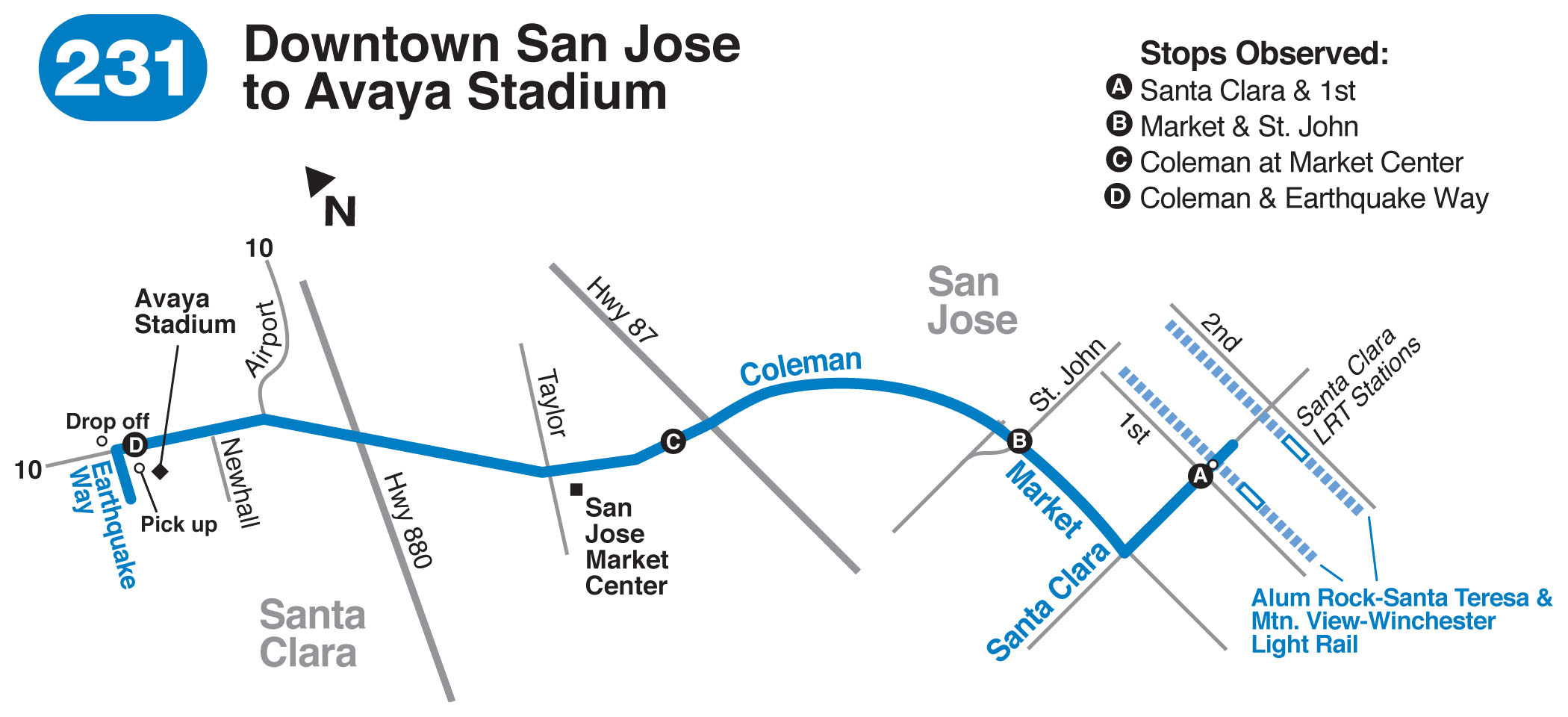
For major games, including internationals, VTA bus No.231 also operates every 15min from downtown Santa Clara & 1st, and Market & St John by bar-lined San Pedro Square, journey time 20min.
A Single Ride is $2, paid on board. For a Day Pass ($6) you need a rechargeable Clipper Card. You can also pre-purchase through the VTA mobile app EventTIK, a better buy when traveling as a group.
If you’re coming by Caltrain to Santa Clara from San Francisco, there’s an integrated ticket with a VTA Day Pass for an extra $6. Other rail services using Santa Clara include ACE, Amtrak and Capital Corridor.
Stadium
It has been a long time coming but the opening of Avaya Stadium on the eve of MLS 2015 has put an end to San Jose Earthquakes playing in front of four-figure crowds at college sports grounds.
This is soccer watching as never before in MLS.
Set beside San Jose International Airport and the rail line that serves California, Avaya Stadium is perfectly connected for the slowly burgeoning breed of traveling soccer fan. Away support for the California Clásico with LA Galaxy is a given, with trouble breaking out at one game in 2012, at the Buck Shaw Stadium not half a mile from Avaya.
Avaya is unique in that it has the only safe standing section in MLS, in the home South Stand, plus patio seating, with tables, paid for by the season. Steep sightlines surround all four sides – including the open fan zone around the signature bar, stretching 300-plus feet below the video scoreboard. The concourse in the main West Stand features high-tech screens displaying fans’ Tweets as they are sent.
This is a soccer stadium for the 21st century.
Visiting supporters are allocated the top of sector 134 nearest the north, Scoreboard End. Designated Earthquakes Supporters’ Group sectors are 117 and 118.
[mapsmarker layer="301"]
Transport
Close to Avaya Stadium, San Jose International Airport and multi-connected Santa Clara station are linked by local VTA bus No.10, via Coleman & Earthquakes, the designated soccer stop a few minutes’ ride from either.
Weekend and evening services run every 30min.
For major games, including internationals, VTA bus No.231 also operates every 15min from downtown Santa Clara & 1st, and Market & St John by bar-lined San Pedro Square, journey time 20min.
A Single Ride is $2, paid on board. For a Day Pass ($6) you need a rechargeable Clipper Card. You can also pre-purchase through the VTA mobile app EventTIK, a better buy when traveling as a group.
If you’re coming by Caltrain to Santa Clara from San Francisco, there’s an integrated ticket with a VTA Day Pass for an extra $6. Other rail services using Santa Clara include ACE, Amtrak and Capital Corridor.
 Coming back after the match, the boarding location for each bus service, the No.10 to Santa Clara/airport, the No.232 to downtown San Jose, is by the main entrance, on the west side of the big scoreboard, ie not the side with the gas station on it.
By car, you’re heading for Avaya Stadium 1123 Colman Ave, San Jose CA 95110. From San Jose, take Highway 87 Northbound, merge onto Highway 101 Northbound, take the Trimble Rd/De La Cruz Blvd exit 391, merge left onto W Trimble Rd and continue onto De La Cruz Blvd, then take a slight left onto Coleman Ave – signs will lead you to Avaya Stadium. From San Francisco, take Highway 101 Southbound.
Parking lots open four hours before kickoff. Silver Silver Parking is $20, $15 in the Overflow behind VIP Parking.
Coming back after the match, the boarding location for each bus service, the No.10 to Santa Clara/airport, the No.232 to downtown San Jose, is by the main entrance, on the west side of the big scoreboard, ie not the side with the gas station on it.
By car, you’re heading for Avaya Stadium 1123 Colman Ave, San Jose CA 95110. From San Jose, take Highway 87 Northbound, merge onto Highway 101 Northbound, take the Trimble Rd/De La Cruz Blvd exit 391, merge left onto W Trimble Rd and continue onto De La Cruz Blvd, then take a slight left onto Coleman Ave – signs will lead you to Avaya Stadium. From San Francisco, take Highway 101 Southbound.
Parking lots open four hours before kickoff. Silver Silver Parking is $20, $15 in the Overflow behind VIP Parking.
 Ticketing
With the first games of 2017 an 18,000-capacity sell-out, availability is now most certainly an issue. Single-match sales for the whole season are distributed online but get in quick. For any that may still be available, the Will Call and ticket offices beside Earthquakes Way open 2hrs or so before kickoff.
Premium and center circle seats are priced around $70. Sideline seats are around $50-$70, Corner Flag $35-$60, End Zone $30, supporters’ sections $28. Visiting supporters are charged around $35.
For more information, call 408-556-7700.
Ticketing
With the first games of 2017 an 18,000-capacity sell-out, availability is now most certainly an issue. Single-match sales for the whole season are distributed online but get in quick. For any that may still be available, the Will Call and ticket offices beside Earthquakes Way open 2hrs or so before kickoff.
Premium and center circle seats are priced around $70. Sideline seats are around $50-$70, Corner Flag $35-$60, End Zone $30, supporters’ sections $28. Visiting supporters are charged around $35.
For more information, call 408-556-7700.
 Merchandise
The club has two outlets, a store at the stadium (Mon-Fri 10am-3pm, 2hrs before kickoff) and a kiosk on the first floor of Westfield Oakridge mall (Mon-Thur 10am-9pm, Fri-Sat 10am-10pm, Sun 11am-7.30pm) south of San Jose, enter through Sears or Macy’s.
Primary (black/blue) and secondary (red/white) jerseys can be customized by player, you’ll find Earthquakes shades, USBs, keyboards and chargers, cooler bags and growlers for tailgating, and ‘Forward As One’ hoodies.
Tailgaiting
Anywhere but VIP Parking is fair game for tailgating. There’s plenty in Silver Lot where the Ultras meet, while long-established Casbah and The Faultline of more recent seasons gather in Gold Lot.
Tours
Stadium tours are available Mon-Fri 9am-5pm except on match days. Contact through the Chat Now link on the club website.
Merchandise
The club has two outlets, a store at the stadium (Mon-Fri 10am-3pm, 2hrs before kickoff) and a kiosk on the first floor of Westfield Oakridge mall (Mon-Thur 10am-9pm, Fri-Sat 10am-10pm, Sun 11am-7.30pm) south of San Jose, enter through Sears or Macy’s.
Primary (black/blue) and secondary (red/white) jerseys can be customized by player, you’ll find Earthquakes shades, USBs, keyboards and chargers, cooler bags and growlers for tailgating, and ‘Forward As One’ hoodies.
Tailgaiting
Anywhere but VIP Parking is fair game for tailgating. There’s plenty in Silver Lot where the Ultras meet, while long-established Casbah and The Faultline of more recent seasons gather in Gold Lot.
Tours
Stadium tours are available Mon-Fri 9am-5pm except on match days. Contact through the Chat Now link on the club website.
 Beers
The longest outdoor bar in America is no idle boast – and that’s what stretches under the scoreboard at the north end of Avaya Stadium. Manned by 30-plus bartenders, facilitated by 18 HD TVs, the Scoreboard Bar has provided the signature wow factor since the stadium opening in 2015. Earthquakes supporters in the South Stand can also avail themselves of the Beers of the World stand with a rotating selection of global brews.
For prematch, the stadium location out by the airport means that it’s easier to drink around San Pedro Square downtown. And if the No.231 stadium bus is running, it calls at Market & St John alongside.
The San Pedro Square Market Bar itself is a fine place to start, an abundance of ales, beers, wines and cocktails, a world of food, rows of TVs showing sports and, most of all, all kinds of people passing by to enjoy them. Live music on weekends too.
Beers
The longest outdoor bar in America is no idle boast – and that’s what stretches under the scoreboard at the north end of Avaya Stadium. Manned by 30-plus bartenders, facilitated by 18 HD TVs, the Scoreboard Bar has provided the signature wow factor since the stadium opening in 2015. Earthquakes supporters in the South Stand can also avail themselves of the Beers of the World stand with a rotating selection of global brews.
For prematch, the stadium location out by the airport means that it’s easier to drink around San Pedro Square downtown. And if the No.231 stadium bus is running, it calls at Market & St John alongside.
The San Pedro Square Market Bar itself is a fine place to start, an abundance of ales, beers, wines and cocktails, a world of food, rows of TVs showing sports and, most of all, all kinds of people passing by to enjoy them. Live music on weekends too.
 Around the corner, Peggy Sue’s is all retro and quality burgers, Firehouse No.1 is a notch-above gastro pub lined with craft beers, while the Old Wagon Saloon & Grill is a chain and feels like it, but shows sports.
As for expat-type pubs, nearby on W St Clara Street The Brit, aka Britannia Arms, is prime sports territory, with drinks specials on Sunday, Monday and Tuesday nights. DJs spin Thursdays through Saturdays. Happy hours are currently Mondays through Fridays, 4pm-7pm. Back on San Pedro Square, O’Flaherty’s puts the focus on beer, all 54 taps of it, with rotating import craft brews, plus the largest selection of whiskeys in town. The kitchen runs seven days a week. Game Day here is mainly geared to NFL, Sharks hockey and baseball.
San Jose Timeline
1974 Milan Mandarić, a Yugoslav-born millionaire who made his fortune in computer components, brings soccer to San Jose. NASL team Earthquakes attracts near 20,000 crowds to Spartan Stadium. Gates later dwindle despite the two-season presence of a now wayward George Best.
1975 San Jose Earthquakes plays in MISL indoor soccer at Cow Palace, winning inaugural title. Best takes part before his move to Hong Kong in 1982.
1983 Team becomes Golden Bay Earthquakes but little change in form or gate revenue.
1985 With NASL collapse, renamed San Jose Earthquakes wins the Western Alliance Challenge Series against teams from Seattle, Portland and British Columbia in Canada, Victoria Riptides.
1986 WACS becomes Western Soccer Alliance, won by Hollywood Kickers. Earthquakes finishes below San Diego Nomads.
1987 San Jose Earthquakes loses to San Diego Nomads in WSA Final.
1988 Former San Jose striker Chance Fry scores the fifth of five unanswered goals as Seattle Storm whitewashes Earthquakes at the last WSA Final.
1989 Earthquakes becomes San Francisco Blackhawks for inaugural and doomed Western Soccer League. Loses to San Diego Nomads in Final. Players include Earthquakes’ later long-term general manager John Doyle and current coach Dominic Kinnear.
1990 WSL merges with West Coast American Soccer League to create the American Professional Soccer League. Blackhawks loses Final to Maryland Bays on penalty kicks. Defender Marcelo Balboa, later the first US international to reach 100 caps, begins professional career at Spartan Stadium. Blackhawks wins trophy in 1991 over Albany Capitals.
1992 Blackhawks hits the big time with appearance in CONCACAF Champions’ Cup, losing to Mexico’s Club América featuring national hero Hugo Sánchez after successful career at Real Madrid.
1993 Blackhawks renamed San Jose Hawks, playing in USISL.
1994 League-owned franchise San Jose Clash formed, based at Spartan Stadium.
1996 Clash plays inaugural MLS game, a 1-0 win over DC United, star player Eric Wynalda scoring the only goal. Club later reverts to name San Jose Earthquakes.
2015 Avaya Stadium opens, Earthquakes plays curtain-raising friendly with eternal rivals LA Galaxy."
["post_title"]=>
string(20) "San Jose Earthquakes"
["post_excerpt"]=>
string(0) ""
["post_status"]=>
string(7) "publish"
["comment_status"]=>
string(6) "closed"
["ping_status"]=>
string(4) "open"
["post_password"]=>
string(0) ""
["post_name"]=>
string(20) "san-jose-earthquakes"
["to_ping"]=>
string(0) ""
["pinged"]=>
string(0) ""
["post_modified"]=>
string(19) "2020-09-16 02:19:01"
["post_modified_gmt"]=>
string(19) "2020-09-16 02:19:01"
["post_content_filtered"]=>
string(0) ""
["post_parent"]=>
int(0)
["guid"]=>
string(36) "https://old.liberoguide.com/?p=23025"
["menu_order"]=>
int(0)
["post_type"]=>
string(4) "post"
["post_mime_type"]=>
string(0) ""
["comment_count"]=>
string(1) "0"
["filter"]=>
string(3) "raw"
}
[3]=>
object(WP_Post)#4038 (24) {
["ID"]=>
int(20777)
["post_author"]=>
string(1) "3"
["post_date"]=>
string(19) "2016-11-27 23:42:44"
["post_date_gmt"]=>
string(19) "2016-11-27 23:42:44"
["post_content"]=>
string(18645) "Toronto F.C. became the first Canadian Major League Soccer franchise in 2007 after professional sports and real estate firm Maple Leaf Sports & Entertainment stumped up a CA$10 million expansion fee to join. The Reds began play under the stewardship of former Scotland striker Maurice Johnston and with the backing of raucous sellout crowds at its new purpose-built BMO Field stadium.
Around the corner, Peggy Sue’s is all retro and quality burgers, Firehouse No.1 is a notch-above gastro pub lined with craft beers, while the Old Wagon Saloon & Grill is a chain and feels like it, but shows sports.
As for expat-type pubs, nearby on W St Clara Street The Brit, aka Britannia Arms, is prime sports territory, with drinks specials on Sunday, Monday and Tuesday nights. DJs spin Thursdays through Saturdays. Happy hours are currently Mondays through Fridays, 4pm-7pm. Back on San Pedro Square, O’Flaherty’s puts the focus on beer, all 54 taps of it, with rotating import craft brews, plus the largest selection of whiskeys in town. The kitchen runs seven days a week. Game Day here is mainly geared to NFL, Sharks hockey and baseball.
San Jose Timeline
1974 Milan Mandarić, a Yugoslav-born millionaire who made his fortune in computer components, brings soccer to San Jose. NASL team Earthquakes attracts near 20,000 crowds to Spartan Stadium. Gates later dwindle despite the two-season presence of a now wayward George Best.
1975 San Jose Earthquakes plays in MISL indoor soccer at Cow Palace, winning inaugural title. Best takes part before his move to Hong Kong in 1982.
1983 Team becomes Golden Bay Earthquakes but little change in form or gate revenue.
1985 With NASL collapse, renamed San Jose Earthquakes wins the Western Alliance Challenge Series against teams from Seattle, Portland and British Columbia in Canada, Victoria Riptides.
1986 WACS becomes Western Soccer Alliance, won by Hollywood Kickers. Earthquakes finishes below San Diego Nomads.
1987 San Jose Earthquakes loses to San Diego Nomads in WSA Final.
1988 Former San Jose striker Chance Fry scores the fifth of five unanswered goals as Seattle Storm whitewashes Earthquakes at the last WSA Final.
1989 Earthquakes becomes San Francisco Blackhawks for inaugural and doomed Western Soccer League. Loses to San Diego Nomads in Final. Players include Earthquakes’ later long-term general manager John Doyle and current coach Dominic Kinnear.
1990 WSL merges with West Coast American Soccer League to create the American Professional Soccer League. Blackhawks loses Final to Maryland Bays on penalty kicks. Defender Marcelo Balboa, later the first US international to reach 100 caps, begins professional career at Spartan Stadium. Blackhawks wins trophy in 1991 over Albany Capitals.
1992 Blackhawks hits the big time with appearance in CONCACAF Champions’ Cup, losing to Mexico’s Club América featuring national hero Hugo Sánchez after successful career at Real Madrid.
1993 Blackhawks renamed San Jose Hawks, playing in USISL.
1994 League-owned franchise San Jose Clash formed, based at Spartan Stadium.
1996 Clash plays inaugural MLS game, a 1-0 win over DC United, star player Eric Wynalda scoring the only goal. Club later reverts to name San Jose Earthquakes.
2015 Avaya Stadium opens, Earthquakes plays curtain-raising friendly with eternal rivals LA Galaxy."
["post_title"]=>
string(20) "San Jose Earthquakes"
["post_excerpt"]=>
string(0) ""
["post_status"]=>
string(7) "publish"
["comment_status"]=>
string(6) "closed"
["ping_status"]=>
string(4) "open"
["post_password"]=>
string(0) ""
["post_name"]=>
string(20) "san-jose-earthquakes"
["to_ping"]=>
string(0) ""
["pinged"]=>
string(0) ""
["post_modified"]=>
string(19) "2020-09-16 02:19:01"
["post_modified_gmt"]=>
string(19) "2020-09-16 02:19:01"
["post_content_filtered"]=>
string(0) ""
["post_parent"]=>
int(0)
["guid"]=>
string(36) "https://old.liberoguide.com/?p=23025"
["menu_order"]=>
int(0)
["post_type"]=>
string(4) "post"
["post_mime_type"]=>
string(0) ""
["comment_count"]=>
string(1) "0"
["filter"]=>
string(3) "raw"
}
[3]=>
object(WP_Post)#4038 (24) {
["ID"]=>
int(20777)
["post_author"]=>
string(1) "3"
["post_date"]=>
string(19) "2016-11-27 23:42:44"
["post_date_gmt"]=>
string(19) "2016-11-27 23:42:44"
["post_content"]=>
string(18645) "Toronto F.C. became the first Canadian Major League Soccer franchise in 2007 after professional sports and real estate firm Maple Leaf Sports & Entertainment stumped up a CA$10 million expansion fee to join. The Reds began play under the stewardship of former Scotland striker Maurice Johnston and with the backing of raucous sellout crowds at its new purpose-built BMO Field stadium.
 The first five games set a woeful blueprint that dogged much of TFC’s first decade. It took 384 minutes for the team to score its first goal thanks to Danny Dichio. The ex-QPR striker also became the first Toronto player to be sent off shortly afterward as the Reds secured its first points with a 3-1 win over Chicago Fire.
Failure to reach the MLS playoffs in the first four years saw Dutchman Aron Winter installed as head coach for the 2011 season under the recommendation of Jürgen Klinsmann. Veteran German midfielder Torsten Frings arrived as a designated player as Toronto assembled one of the league’s highest paid squads. Results still proved elusive. Winter was dismissed during a dismal 2012 campaign that ended with a 14-game winless streak and weary fans donning paper bags over their heads at games.
Toronto found further funds in 2014 to sign Spurs striker Jermain Defoe and U.S. international Michael Bradley. Defoe, partly persuaded by famed Toronto rapper Drake, was reputed to be on a four-year contract worth £90,000 a week. England manager Roy Hodgson duly discarded Defoe from his World Cup plans and form dissipated shortly afterward. Toronto missed the playoffs again and Defoe returned home after a swap deal for Sunderland’s misfiring U.S. striker Jozy Altidore.
The first five games set a woeful blueprint that dogged much of TFC’s first decade. It took 384 minutes for the team to score its first goal thanks to Danny Dichio. The ex-QPR striker also became the first Toronto player to be sent off shortly afterward as the Reds secured its first points with a 3-1 win over Chicago Fire.
Failure to reach the MLS playoffs in the first four years saw Dutchman Aron Winter installed as head coach for the 2011 season under the recommendation of Jürgen Klinsmann. Veteran German midfielder Torsten Frings arrived as a designated player as Toronto assembled one of the league’s highest paid squads. Results still proved elusive. Winter was dismissed during a dismal 2012 campaign that ended with a 14-game winless streak and weary fans donning paper bags over their heads at games.
Toronto found further funds in 2014 to sign Spurs striker Jermain Defoe and U.S. international Michael Bradley. Defoe, partly persuaded by famed Toronto rapper Drake, was reputed to be on a four-year contract worth £90,000 a week. England manager Roy Hodgson duly discarded Defoe from his World Cup plans and form dissipated shortly afterward. Toronto missed the playoffs again and Defoe returned home after a swap deal for Sunderland’s misfiring U.S. striker Jozy Altidore.
 The same week that Defoe set off for the Stadium of Light in January 2015, TFC made the signing that reversed eight years of failure and fan disgruntlement. Just turning 28, Italian international Sebastian Giovinco was at the peak of his powers, despite having fallen out of favor slightly at Juventus. But the Turin-born creative midfielder had represented Italy at every level from under-16s up, including 23 games for the Azzurri. This was a class act looking to further his career at, with and for Toronto F.C..
Then the highest paid player in MLS, Giovinco made an instant difference to TFC fortunes. Goals and assists came thick and fast, the previously lumbering Altidore also benefiting from the Italian’s selfless slide-rule passing. Giovinco could score, too, such as his nine-minute hat trick at New York City F.C..
If anything typified Giovinco, it was his mazy goal to beat New York Red Bulls in October 2015. Not only did this Goal of the Year nomination gain TFC a first ever MLS playoff place and but it was scored by someone who had been playing for Italy 4,000 miles away in Rome only 24 hours previously.
The same week that Defoe set off for the Stadium of Light in January 2015, TFC made the signing that reversed eight years of failure and fan disgruntlement. Just turning 28, Italian international Sebastian Giovinco was at the peak of his powers, despite having fallen out of favor slightly at Juventus. But the Turin-born creative midfielder had represented Italy at every level from under-16s up, including 23 games for the Azzurri. This was a class act looking to further his career at, with and for Toronto F.C..
Then the highest paid player in MLS, Giovinco made an instant difference to TFC fortunes. Goals and assists came thick and fast, the previously lumbering Altidore also benefiting from the Italian’s selfless slide-rule passing. Giovinco could score, too, such as his nine-minute hat trick at New York City F.C..
If anything typified Giovinco, it was his mazy goal to beat New York Red Bulls in October 2015. Not only did this Goal of the Year nomination gain TFC a first ever MLS playoff place and but it was scored by someone who had been playing for Italy 4,000 miles away in Rome only 24 hours previously.
 Although Toronto was beaten by bitter rivals Montreal in the first 401 Derby at the playoff stage, Giovinco scooped up a host of annual awards, not least equal top goalscorer, top assist provider and 2015 MVP.
Gaining revenge at Montreal early in the 2016 campaign by scoring the only two goals of the game, Giovinco became TFC’s all-time top scorer in MLS with 28 goals in 40 games. Average crowds at BMO Field crept ever closer to its new 30,000-plus capacity.
Adding a first Canadian Championship for four years, in October 2016, TFC gained a playoff place for the second consecutive year, before dispatching New York City 7-0 over two legs, an MLS postseason record aggregate tally.
With an Eastern Conference Final set up beautifully between Toronto and Montreal, the script is screaming for a first Canadian champion of MLS in 2016. The only question is… which one?
Although Toronto was beaten by bitter rivals Montreal in the first 401 Derby at the playoff stage, Giovinco scooped up a host of annual awards, not least equal top goalscorer, top assist provider and 2015 MVP.
Gaining revenge at Montreal early in the 2016 campaign by scoring the only two goals of the game, Giovinco became TFC’s all-time top scorer in MLS with 28 goals in 40 games. Average crowds at BMO Field crept ever closer to its new 30,000-plus capacity.
Adding a first Canadian Championship for four years, in October 2016, TFC gained a playoff place for the second consecutive year, before dispatching New York City 7-0 over two legs, an MLS postseason record aggregate tally.
With an Eastern Conference Final set up beautifully between Toronto and Montreal, the script is screaming for a first Canadian champion of MLS in 2016. The only question is… which one?
 Stadium
BMO Field is located within Toronto’s Exhibition Place district, about two miles west of downtown on the shoreline of Lake Ontario.
Here once stood the Exhibition Stadium, home of Toronto Blizzard in the NASL days. Demolished in 1999, it was known for the wind and snow that used to blow in off the lake. They didn’t call the soccer team Blizzard for nothing.
With baseball, gridiron football and basketball moved to Toronto’s downtown SkyDome, now called Rogers Centre, it was agreed that a new arena being built on the site of the old Exhibition Stadium should be soccer-specific.
Part-funded by two levels of government and the City of Toronto, BMO Field is overseen by Maple Leaf Sports & Entertainment of Toronto Maple Leafs fame. Originally, CFL team the Toronto Argonauts had proposed a new stadium here but Canada’s bid to host the 2007 U-20 World Cup swayed the authorities to go with soccer.
Stadium
BMO Field is located within Toronto’s Exhibition Place district, about two miles west of downtown on the shoreline of Lake Ontario.
Here once stood the Exhibition Stadium, home of Toronto Blizzard in the NASL days. Demolished in 1999, it was known for the wind and snow that used to blow in off the lake. They didn’t call the soccer team Blizzard for nothing.
With baseball, gridiron football and basketball moved to Toronto’s downtown SkyDome, now called Rogers Centre, it was agreed that a new arena being built on the site of the old Exhibition Stadium should be soccer-specific.
Part-funded by two levels of government and the City of Toronto, BMO Field is overseen by Maple Leaf Sports & Entertainment of Toronto Maple Leafs fame. Originally, CFL team the Toronto Argonauts had proposed a new stadium here but Canada’s bid to host the 2007 U-20 World Cup swayed the authorities to go with soccer.
 MLSE, keen on a soccer franchise, as well as contributing CA$8 million toward construction, paid CA$10 for the naming rights, sold on to Bank of Montreal (‘BOM’) for nearly three times that amount.
With work started in March 2006, in May Toronto F.C. was named as the first Canadian team in MLS.
Unveiled in April 2007 with a TFC defeat against Kansas City Wizards, officially opened that May, BMO Field was referred to as ‘National Soccer Stadium’ for its role as main venue for the U-20 World Cup that summer. With crowds at a then near-capacity 20,195 and an artificial surface, the new arena proved the perfect stage for tournament MVP Sergio Agüero and fellow 2014 World Cup star Ángel Di María, winners with Argentina. Later TFC lynchpins Michael Bradley and Jozy Altidore scored vital goals for U.S.A..
Despite poor form from its home team, BMO Field averaged a 20,000-plus attendance for its first five years as an MLS stadium, 16,000 of these season-ticket holders. Fan groups such as Red Patch Boys, U-Sector and Original 109 created a real soccer atmosphere.
After a natural grass field was laid in 2010, a further CA$120 million renovation between 2014-16 saw an extra tier added to the East Stand and roof added, plus the pitch reconfigured for gridiron football.
Capacity has risen to an official 30,228, perfect for the rise of superstar Sebastian Giovinco and his Italianate following in Section 114, Inebriatti. Average gates for 2016 passed 26,500, with a record 30,262 set for the visit of New York City FC in May.
MLSE, keen on a soccer franchise, as well as contributing CA$8 million toward construction, paid CA$10 for the naming rights, sold on to Bank of Montreal (‘BOM’) for nearly three times that amount.
With work started in March 2006, in May Toronto F.C. was named as the first Canadian team in MLS.
Unveiled in April 2007 with a TFC defeat against Kansas City Wizards, officially opened that May, BMO Field was referred to as ‘National Soccer Stadium’ for its role as main venue for the U-20 World Cup that summer. With crowds at a then near-capacity 20,195 and an artificial surface, the new arena proved the perfect stage for tournament MVP Sergio Agüero and fellow 2014 World Cup star Ángel Di María, winners with Argentina. Later TFC lynchpins Michael Bradley and Jozy Altidore scored vital goals for U.S.A..
Despite poor form from its home team, BMO Field averaged a 20,000-plus attendance for its first five years as an MLS stadium, 16,000 of these season-ticket holders. Fan groups such as Red Patch Boys, U-Sector and Original 109 created a real soccer atmosphere.
After a natural grass field was laid in 2010, a further CA$120 million renovation between 2014-16 saw an extra tier added to the East Stand and roof added, plus the pitch reconfigured for gridiron football.
Capacity has risen to an official 30,228, perfect for the rise of superstar Sebastian Giovinco and his Italianate following in Section 114, Inebriatti. Average gates for 2016 passed 26,500, with a record 30,262 set for the visit of New York City FC in May.
 Transport
BMO Field is easily reached using Toronto’s public transport system.
Exhibition Place is one stop west of the city’s Union Station on the GO Train. Single rides cost CA$5.30 from ticket vending machines – Union Station’s accept cash and cards.
Toronto Transit Commission also operates streetcars from downtown to Exhibition Place. Increased service is laid on for game days. Fans can jump on the #509 Harbourfront streetcar from Union Station along Lake Shore Boulevard West. The #511 service runs down focal Bathurst Street. Single rides are CA$3.25 from cash-only token vending machines.
[mapsmarker layer="260"]
Bike Share Toronto has kiosks across the city and safe designated bike lanes. A 24-hour pass costs CA$7 and offers unlimited 30-minute trips. The rental stations on Lake Shore Boulevard West and Queen Street West are within a short walk of the stadium.
The stadium address is BMO Field, 170 Princes’ Boulevard, Toronto, ON M6K 3C3.
Driving from the airport, take 427 south, merge onto Gardiner Expressway E via the exit on the left. Take the Lake Shore Blvd W. exit, then turn left onto Ontario Dr. for the stadium.
Parking at the stadium is CA$30 on TFC match days. There are three lots for surface parking (Red P). Pay a booth attendant for 2 & 4, 3 is pay-and-display, card only. Underground parking is indicated with a Yellow P.
Transport
BMO Field is easily reached using Toronto’s public transport system.
Exhibition Place is one stop west of the city’s Union Station on the GO Train. Single rides cost CA$5.30 from ticket vending machines – Union Station’s accept cash and cards.
Toronto Transit Commission also operates streetcars from downtown to Exhibition Place. Increased service is laid on for game days. Fans can jump on the #509 Harbourfront streetcar from Union Station along Lake Shore Boulevard West. The #511 service runs down focal Bathurst Street. Single rides are CA$3.25 from cash-only token vending machines.
[mapsmarker layer="260"]
Bike Share Toronto has kiosks across the city and safe designated bike lanes. A 24-hour pass costs CA$7 and offers unlimited 30-minute trips. The rental stations on Lake Shore Boulevard West and Queen Street West are within a short walk of the stadium.
The stadium address is BMO Field, 170 Princes’ Boulevard, Toronto, ON M6K 3C3.
Driving from the airport, take 427 south, merge onto Gardiner Expressway E via the exit on the left. Take the Lake Shore Blvd W. exit, then turn left onto Ontario Dr. for the stadium.
Parking at the stadium is CA$30 on TFC match days. There are three lots for surface parking (Red P). Pay a booth attendant for 2 & 4, 3 is pay-and-display, card only. Underground parking is indicated with a Yellow P.
 Ticketing
There are two ticket offices at the Northeast corner of the stadium near Gate 1, one operated by Air Canada, the other BMO Field (Apr-Nov Mon-Fri 10am-6pm, match days).
There are telephone sales at Toronto FC Goal Line, 416-360-GOAL (4625), and Ticketmaster 1-855-985-4625. Will Call windows are by the Ticket Office near Gate 1. ID is required and lines will be long.
Online sales are through www.ticketmaster.ca and the club.
Prices vary from match to match. For the visit of New York City, say, you pay CA$90 for a good seat in the East or West Red sections near the halfway line, CA$28 in the East or West Grey sections near the corners, and around CA$45 in between. Standing places in the Yellow Southend with the home fans is CA$23 but these will be a premium.
Visiting supporters feel most comfortable in Sectors 104 and 105 in the quieter, Northeast corner of the stadium, away from the Southside (111-119), but these are rarely specified unless against against Canadian teams or from Northeastern U.S..
If availability is a problem, you can usually find seats through StubHub.
Ticketing
There are two ticket offices at the Northeast corner of the stadium near Gate 1, one operated by Air Canada, the other BMO Field (Apr-Nov Mon-Fri 10am-6pm, match days).
There are telephone sales at Toronto FC Goal Line, 416-360-GOAL (4625), and Ticketmaster 1-855-985-4625. Will Call windows are by the Ticket Office near Gate 1. ID is required and lines will be long.
Online sales are through www.ticketmaster.ca and the club.
Prices vary from match to match. For the visit of New York City, say, you pay CA$90 for a good seat in the East or West Red sections near the halfway line, CA$28 in the East or West Grey sections near the corners, and around CA$45 in between. Standing places in the Yellow Southend with the home fans is CA$23 but these will be a premium.
Visiting supporters feel most comfortable in Sectors 104 and 105 in the quieter, Northeast corner of the stadium, away from the Southside (111-119), but these are rarely specified unless against against Canadian teams or from Northeastern U.S..
If availability is a problem, you can usually find seats through StubHub.
 Merchandise
Real Sports Apparel carries TFC merchandise from its store (Mon-Fri 10am-7pm, Sat 10am-6pm, Sun 11am-6pm, match days) inside Air Canada Centre at Gate 1. Short-sleeved home and away jerseys are CA$129.99, tees with a T badge CA$34.99 and mesh baseball caps CA$29.99. ‘Toronto Till I Die’ 2016 Playoff hoodies go for CA$69.99.
Merchandise
Real Sports Apparel carries TFC merchandise from its store (Mon-Fri 10am-7pm, Sat 10am-6pm, Sun 11am-6pm, match days) inside Air Canada Centre at Gate 1. Short-sleeved home and away jerseys are CA$129.99, tees with a T badge CA$34.99 and mesh baseball caps CA$29.99. ‘Toronto Till I Die’ 2016 Playoff hoodies go for CA$69.99.
 Concessions
You’ll find the ‘At The Game’ stadium branch of the vast downtown Real Sports Bar & Grill at Section 105, Second Level, with chicken wings in ten flavors, Real burgers with RS sauce and a smaller selection of the beers on offer at Maple Leaf Square (see Beers).
Behind the North Patio, Budweiser King Club sells domestic and premium types. Elsewhere around the stadium specialist beers now feature Tankhouse Ale, 100th Meridian and West Coast Style IPA from Mill Street Brewery in Toronto’s Distillery District.
Among the concessions stands, Smoke’s Poutinerie offers all variations of the classic Canadian fast-food dish.
Concessions
You’ll find the ‘At The Game’ stadium branch of the vast downtown Real Sports Bar & Grill at Section 105, Second Level, with chicken wings in ten flavors, Real burgers with RS sauce and a smaller selection of the beers on offer at Maple Leaf Square (see Beers).
Behind the North Patio, Budweiser King Club sells domestic and premium types. Elsewhere around the stadium specialist beers now feature Tankhouse Ale, 100th Meridian and West Coast Style IPA from Mill Street Brewery in Toronto’s Distillery District.
Among the concessions stands, Smoke’s Poutinerie offers all variations of the classic Canadian fast-food dish.
 Beers
Sports bars are concentrated in Toronto’s Entertainment District, around Union Station, so extremely convenient before the short commute to BMO Field.
There, the Flatiron & Firkin carries the added attraction of being located in the basement of the city’s historic Flatiron building three blocks from the station. Outdoor seating is available in summer. Premium tap beers include Hop City Barking Squirrel and Muskoka Detour while there’s a British touch to the menu, with its shepherd’s pies and fish & chips. Live TV sports too.
Perfectly located to pick up the #511 streetcar to BMO Field, Football Factory opens 7am on weekends for English Premier League action, serves Goose Island Honkers Ale, Hoegaarden and Boddington’s, and offers Factory wraps with steak, chorizo and bacon.
Beers
Sports bars are concentrated in Toronto’s Entertainment District, around Union Station, so extremely convenient before the short commute to BMO Field.
There, the Flatiron & Firkin carries the added attraction of being located in the basement of the city’s historic Flatiron building three blocks from the station. Outdoor seating is available in summer. Premium tap beers include Hop City Barking Squirrel and Muskoka Detour while there’s a British touch to the menu, with its shepherd’s pies and fish & chips. Live TV sports too.
Perfectly located to pick up the #511 streetcar to BMO Field, Football Factory opens 7am on weekends for English Premier League action, serves Goose Island Honkers Ale, Hoegaarden and Boddington’s, and offers Factory wraps with steak, chorizo and bacon.
 Other convenient options for the #511 include the nearby Wheat Sheaf Tavern, dating back to 1849, offering character and TV sports amid the tourist-friendly gleam elsewhere; and Foggy Dew Irish pub & restaurant, with live music.
For industrial-scale sports gawping, by Air Canada Centre Real Sports Bar & Grill has 199 (!) HD TVs, a 39-footer HD screen and 126 draught beer taps, and, round the corner, Hoops Sports Bar & Grill, with wall-to-wall TVs and 19 beers on draught.
Ontario chain Shoeless Joe’s has one of its sports bars in the Liberty Village neighborhood a 15-minute walk from BMO Field. Its proximity to the stadium makes it a popular pre- and post-game haunt for Toronto’s Red Patch Boys supporters’ group.
Other convenient options for the #511 include the nearby Wheat Sheaf Tavern, dating back to 1849, offering character and TV sports amid the tourist-friendly gleam elsewhere; and Foggy Dew Irish pub & restaurant, with live music.
For industrial-scale sports gawping, by Air Canada Centre Real Sports Bar & Grill has 199 (!) HD TVs, a 39-footer HD screen and 126 draught beer taps, and, round the corner, Hoops Sports Bar & Grill, with wall-to-wall TVs and 19 beers on draught.
Ontario chain Shoeless Joe’s has one of its sports bars in the Liberty Village neighborhood a 15-minute walk from BMO Field. Its proximity to the stadium makes it a popular pre- and post-game haunt for Toronto’s Red Patch Boys supporters’ group.
 Toronto Timeline
Soccer in Toronto dates back to the mid-1800s with the first recorded association outside of Great Britain being established here in 1877.
1961 Tottenham Hotspur’s double-winning captain Danny Blanchflower and storied English internationalists Stanley Matthews and Johnny Haynes represent Toronto City in the newly formed Eastern Canada Professional Soccer League.
1967 Scottish side Hibernian compete under the guise of Toronto City during the inaugural United Soccer Association tournament. The University of Toronto’s Varsity Stadium serves as the team’s home venue while also being used by the rival Toronto Falcons franchise competing in the inaugural National Professional Soccer League.
1968 The merger of the USA and NPSL into the North American Soccer League leads to the demise of Toronto City after one season. The Falcons averages 5,336 fans for its second year before financial troubles cause it to fold.
Toronto Timeline
Soccer in Toronto dates back to the mid-1800s with the first recorded association outside of Great Britain being established here in 1877.
1961 Tottenham Hotspur’s double-winning captain Danny Blanchflower and storied English internationalists Stanley Matthews and Johnny Haynes represent Toronto City in the newly formed Eastern Canada Professional Soccer League.
1967 Scottish side Hibernian compete under the guise of Toronto City during the inaugural United Soccer Association tournament. The University of Toronto’s Varsity Stadium serves as the team’s home venue while also being used by the rival Toronto Falcons franchise competing in the inaugural National Professional Soccer League.
1968 The merger of the USA and NPSL into the North American Soccer League leads to the demise of Toronto City after one season. The Falcons averages 5,336 fans for its second year before financial troubles cause it to fold.
 1971 Toronto Metros join the NASL with Varsity Stadium again the home field.
1975 The Toronto Croatia sports club acquires a 50% stake in the Metros causing the franchise name to become Toronto Metros-Croatia.
1976 Legendary Portuguese striker Eusébio leads Metros-Croatia to its sole NASL title with the opening goal in a 3-0 win over Minnesota Kicks in the Soccer Bowl final. Average attendances remain below 6,000.
1979 Another takeover results in another name change as Metros-Croatia becomes Toronto Blizzard. Attendance almost doubles during Blizzard’s first season.
1980 A franchise record average attendance of 15,000 watch Blizzard at Varsity Stadium.
1971 Toronto Metros join the NASL with Varsity Stadium again the home field.
1975 The Toronto Croatia sports club acquires a 50% stake in the Metros causing the franchise name to become Toronto Metros-Croatia.
1976 Legendary Portuguese striker Eusébio leads Metros-Croatia to its sole NASL title with the opening goal in a 3-0 win over Minnesota Kicks in the Soccer Bowl final. Average attendances remain below 6,000.
1979 Another takeover results in another name change as Metros-Croatia becomes Toronto Blizzard. Attendance almost doubles during Blizzard’s first season.
1980 A franchise record average attendance of 15,000 watch Blizzard at Varsity Stadium.
 1983 Italian striker Roberto Bettega arrives in Toronto after a storied career with Juventus and Italy. Tulsa Roughnecks halt Toronto’s path to a second NASL title with a 2-0 Soccer Bowl win watched by over 53,000 fans in Vancouver.
1984 Toronto Blizzard ceases operations at the end of NASL’s final season.
1987 A reformed Toronto Blizzard plays in the inaugural Canadian Soccer League established in the aftermath of the NASL collapse and Canada’s qualification for the 1986 World Cup in Mexico.
1993 The Blizzard joins the American Professional Soccer League after the Canadian Soccer League folds. Low attendances force a switch of home games from Varsity Stadium to Lamport Stadium. Owner Karsten Von Wersebe folds his team at the end of the campaign.
2007 Toronto F.C. begins play in Major League Soccer."
["post_title"]=>
string(12) "Toronto F.C."
["post_excerpt"]=>
string(0) ""
["post_status"]=>
string(7) "publish"
["comment_status"]=>
string(6) "closed"
["ping_status"]=>
string(4) "open"
["post_password"]=>
string(0) ""
["post_name"]=>
string(11) "toronto-f-c"
["to_ping"]=>
string(0) ""
["pinged"]=>
string(0) ""
["post_modified"]=>
string(19) "2020-09-16 02:19:09"
["post_modified_gmt"]=>
string(19) "2020-09-16 02:19:09"
["post_content_filtered"]=>
string(0) ""
["post_parent"]=>
int(0)
["guid"]=>
string(36) "https://old.liberoguide.com/?p=20777"
["menu_order"]=>
int(0)
["post_type"]=>
string(4) "post"
["post_mime_type"]=>
string(0) ""
["comment_count"]=>
string(1) "0"
["filter"]=>
string(3) "raw"
}
[4]=>
object(WP_Post)#4169 (24) {
["ID"]=>
int(20751)
["post_author"]=>
string(1) "3"
["post_date"]=>
string(19) "2016-11-26 17:58:35"
["post_date_gmt"]=>
string(19) "2016-11-26 17:58:35"
["post_content"]=>
string(15876) "Only one of five founding members of Major League Soccer still playing under its original name from the inaugural season of 1996, Denver-based Colorado Rapids has only once been crowned winners.
Owned by ‘Silent’ Stan Kroenke, also Arsenal’s largest shareholder, the club has been playing the soccer-specific new-build stadium, Dick’s Sporting Goods Park in Commerce City, towards Denver International Airport, since 2007.
1983 Italian striker Roberto Bettega arrives in Toronto after a storied career with Juventus and Italy. Tulsa Roughnecks halt Toronto’s path to a second NASL title with a 2-0 Soccer Bowl win watched by over 53,000 fans in Vancouver.
1984 Toronto Blizzard ceases operations at the end of NASL’s final season.
1987 A reformed Toronto Blizzard plays in the inaugural Canadian Soccer League established in the aftermath of the NASL collapse and Canada’s qualification for the 1986 World Cup in Mexico.
1993 The Blizzard joins the American Professional Soccer League after the Canadian Soccer League folds. Low attendances force a switch of home games from Varsity Stadium to Lamport Stadium. Owner Karsten Von Wersebe folds his team at the end of the campaign.
2007 Toronto F.C. begins play in Major League Soccer."
["post_title"]=>
string(12) "Toronto F.C."
["post_excerpt"]=>
string(0) ""
["post_status"]=>
string(7) "publish"
["comment_status"]=>
string(6) "closed"
["ping_status"]=>
string(4) "open"
["post_password"]=>
string(0) ""
["post_name"]=>
string(11) "toronto-f-c"
["to_ping"]=>
string(0) ""
["pinged"]=>
string(0) ""
["post_modified"]=>
string(19) "2020-09-16 02:19:09"
["post_modified_gmt"]=>
string(19) "2020-09-16 02:19:09"
["post_content_filtered"]=>
string(0) ""
["post_parent"]=>
int(0)
["guid"]=>
string(36) "https://old.liberoguide.com/?p=20777"
["menu_order"]=>
int(0)
["post_type"]=>
string(4) "post"
["post_mime_type"]=>
string(0) ""
["comment_count"]=>
string(1) "0"
["filter"]=>
string(3) "raw"
}
[4]=>
object(WP_Post)#4169 (24) {
["ID"]=>
int(20751)
["post_author"]=>
string(1) "3"
["post_date"]=>
string(19) "2016-11-26 17:58:35"
["post_date_gmt"]=>
string(19) "2016-11-26 17:58:35"
["post_content"]=>
string(15876) "Only one of five founding members of Major League Soccer still playing under its original name from the inaugural season of 1996, Denver-based Colorado Rapids has only once been crowned winners.
Owned by ‘Silent’ Stan Kroenke, also Arsenal’s largest shareholder, the club has been playing the soccer-specific new-build stadium, Dick’s Sporting Goods Park in Commerce City, towards Denver International Airport, since 2007.
 The MLS Cup win came in 2010. Key player then, defensive midfielder Pablo Mastroeni, has been Rapids coach since 2014.
Back in 1997, the hero was fellow Argentine-American, 127-cap US defender Marcelo Balboa, whose goals against Kansas City Wizards helped take Rapids to a first MLS Final, a defeat at D.C. United. In 2000, Balboa scored from a spectacular overhead at Columbus Crew to win Goal of the Year. Rapids then failed to get past the Quarterfinal stage of the Playoffs for the third year running.
Staying at the Mile High home stadium of Denver Broncos, rebuilt in 2001, Rapids attracted a league high 20,690 average gate as it made the MLS Semifinals of 2002. Goals from former Colombian World Cup star Carlos Valderrama and ex-Chelsea striker John Spencer proved too much for Dallas Burn in the course of the three-game Western Conference Semifinal, an overtime goal from Mark Chung setting up a Conference Final with eventual winners LA Galaxy.
In 2005, Rapids required penalties to overcome Dallas, the first struck by later Colorado coach Pablo Mastroeni, but LA Galaxy was still too strong in the Conference Final.
The MLS Cup win came in 2010. Key player then, defensive midfielder Pablo Mastroeni, has been Rapids coach since 2014.
Back in 1997, the hero was fellow Argentine-American, 127-cap US defender Marcelo Balboa, whose goals against Kansas City Wizards helped take Rapids to a first MLS Final, a defeat at D.C. United. In 2000, Balboa scored from a spectacular overhead at Columbus Crew to win Goal of the Year. Rapids then failed to get past the Quarterfinal stage of the Playoffs for the third year running.
Staying at the Mile High home stadium of Denver Broncos, rebuilt in 2001, Rapids attracted a league high 20,690 average gate as it made the MLS Semifinals of 2002. Goals from former Colombian World Cup star Carlos Valderrama and ex-Chelsea striker John Spencer proved too much for Dallas Burn in the course of the three-game Western Conference Semifinal, an overtime goal from Mark Chung setting up a Conference Final with eventual winners LA Galaxy.
In 2005, Rapids required penalties to overcome Dallas, the first struck by later Colorado coach Pablo Mastroeni, but LA Galaxy was still too strong in the Conference Final.
 Wearing the burgundy and blue of new owner Kroenke’s sports empire, in 2007 Rapids moved out of the Mile High home of NFL’s Denver Broncos and into a new-build stadium in the suburb of Commerce City.
Upon opening, Dick’s Sporting Goods Park saw the arrival hometown striker Conor Casey and, in 2010, the building of a supporters’ terrace as Rapids gained an ever more vociferous following.
Coming to Denver as part of Stan Kroenke’s Arsenal partnership, former Wycombe Wanderers midfielder Gary Smith had galvanised his Rapids squad during his first full season as coach in 2009.
Impregnable at home, and building up a slow-burn rivalry with fellow Rocky Mountain side Real Salt Lake, Rapids marched past Columbus and San Jose to reach the MLS Cup Final in 2010. Against Dallas in Toronto, a bullish Casey equaliser took a scrappy game to extra time. A Macoumba Kandji shot then deflected off Dallas defender George John to settle the tie, and bring the MLS Cup to Denver for the first and so far only time. Smith became the first English coach to win the trophy.
Wearing the burgundy and blue of new owner Kroenke’s sports empire, in 2007 Rapids moved out of the Mile High home of NFL’s Denver Broncos and into a new-build stadium in the suburb of Commerce City.
Upon opening, Dick’s Sporting Goods Park saw the arrival hometown striker Conor Casey and, in 2010, the building of a supporters’ terrace as Rapids gained an ever more vociferous following.
Coming to Denver as part of Stan Kroenke’s Arsenal partnership, former Wycombe Wanderers midfielder Gary Smith had galvanised his Rapids squad during his first full season as coach in 2009.
Impregnable at home, and building up a slow-burn rivalry with fellow Rocky Mountain side Real Salt Lake, Rapids marched past Columbus and San Jose to reach the MLS Cup Final in 2010. Against Dallas in Toronto, a bullish Casey equaliser took a scrappy game to extra time. A Macoumba Kandji shot then deflected off Dallas defender George John to settle the tie, and bring the MLS Cup to Denver for the first and so far only time. Smith became the first English coach to win the trophy.
 Injuries to Casey, Mastroeni and Kandji during his Cup Final heroics affected similar progress in 2011 and, in 2012, Smith was replaced by former FC Dallas assistant coach Óscar Pareja.
Pareja’s Rapids failing to spark, former club captain Mastroeni came in as coach in 2014.
After a poor first two campaigns, in 2016 Mastroeni welcomed the arrival of legendary US internationals Tim Howard in goal and Jermaine Jones in midfield. With former San Jose midfielder Sam Cronin as captain, Rapids made second spot behind Dallas in the regular season.
Two mighty penalty saves from Howard in front of 17,782 in the deciding home leg of Conference Semifinal then dispatched pre-game favorite LA Galaxy in a shootout.
Twenty years after its formation, approaching a decade at Dick’s Sporting Goods Park, Colorado Rapids missed the presence of keeper Howard in the Conference Final first-leg defeat at Seattle. Another MLS Final, though, is not out of the question.
Injuries to Casey, Mastroeni and Kandji during his Cup Final heroics affected similar progress in 2011 and, in 2012, Smith was replaced by former FC Dallas assistant coach Óscar Pareja.
Pareja’s Rapids failing to spark, former club captain Mastroeni came in as coach in 2014.
After a poor first two campaigns, in 2016 Mastroeni welcomed the arrival of legendary US internationals Tim Howard in goal and Jermaine Jones in midfield. With former San Jose midfielder Sam Cronin as captain, Rapids made second spot behind Dallas in the regular season.
Two mighty penalty saves from Howard in front of 17,782 in the deciding home leg of Conference Semifinal then dispatched pre-game favorite LA Galaxy in a shootout.
Twenty years after its formation, approaching a decade at Dick’s Sporting Goods Park, Colorado Rapids missed the presence of keeper Howard in the Conference Final first-leg defeat at Seattle. Another MLS Final, though, is not out of the question.
 Stadium
Spectacular jagged peaks tower over the soccer-specific Dick’s Sporting Goods Park in Commerce City, towards Denver International Airport, some eight miles from downtown Denver. Here the city melts into the endless prairie, with few other significant buildings in the vicinity.
Before its construction in 2005-07, Colorado Rapids had been based at the home of Denver Broncos at Mile High, attracting record 20,000-plus average crowds in 2002.
Winning awards for design, with an excellent playing surface of Kentucky Bluegrass and centerpiecing a complex of 24 floodlit sports fields, the DSGP stadium has hosted several international matches, including Brazil in a pretournament warm-up before the 2016 World Cup.
For major matches, capacity can rise to 19,734 from its regular 18,061. Average for Rapids in the 2016 regular season was 16,278.
Stadium
Spectacular jagged peaks tower over the soccer-specific Dick’s Sporting Goods Park in Commerce City, towards Denver International Airport, some eight miles from downtown Denver. Here the city melts into the endless prairie, with few other significant buildings in the vicinity.
Before its construction in 2005-07, Colorado Rapids had been based at the home of Denver Broncos at Mile High, attracting record 20,000-plus average crowds in 2002.
Winning awards for design, with an excellent playing surface of Kentucky Bluegrass and centerpiecing a complex of 24 floodlit sports fields, the DSGP stadium has hosted several international matches, including Brazil in a pretournament warm-up before the 2016 World Cup.
For major matches, capacity can rise to 19,734 from its regular 18,061. Average for Rapids in the 2016 regular season was 16,278.
 Transport
The stadium is two miles north of the nearest stop, Central Park (zone B, $2.60), on the newly opened A Line of the RTD light rail network. The line then goes on to Denver Airport ($9 from the center).
From Central Park station, the half-hourly #88 bus runs two stops/8min to 56th & Quebec, about 500 yards from the Halftime Sports Bar on Quebec, and another 500 yards from the stadium.
All in all, it’s time-consuming and impractical by public transit – and parking is included in the price of each match ticket.
[mapsmarker layer="259"]
Nearly 5,000 parking spaces surround the stadium (6000 Victory Way, Commerce City, CO 80022). Lots A and AA are for Rapids Season Ticket Members.
There are three main entrances: Quebec & E. 60th Avenue, Quebec & Prairie Parkway (64th Avenue), and 56th Avenue & Valentia Street. From Denver International Airport, exit on Pena Boulevard toward Interstate 70, before exiting West on E. 56th Avenue. After 10min, turn right, North onto Valentia Street and the stadium.
Also note that Rapids supporters group Centennial 38 runs match-day buses from a number of downtown sports pubs.
Transport
The stadium is two miles north of the nearest stop, Central Park (zone B, $2.60), on the newly opened A Line of the RTD light rail network. The line then goes on to Denver Airport ($9 from the center).
From Central Park station, the half-hourly #88 bus runs two stops/8min to 56th & Quebec, about 500 yards from the Halftime Sports Bar on Quebec, and another 500 yards from the stadium.
All in all, it’s time-consuming and impractical by public transit – and parking is included in the price of each match ticket.
[mapsmarker layer="259"]
Nearly 5,000 parking spaces surround the stadium (6000 Victory Way, Commerce City, CO 80022). Lots A and AA are for Rapids Season Ticket Members.
There are three main entrances: Quebec & E. 60th Avenue, Quebec & Prairie Parkway (64th Avenue), and 56th Avenue & Valentia Street. From Denver International Airport, exit on Pena Boulevard toward Interstate 70, before exiting West on E. 56th Avenue. After 10min, turn right, North onto Valentia Street and the stadium.
Also note that Rapids supporters group Centennial 38 runs match-day buses from a number of downtown sports pubs.
 Ticketing
For advance sales, the Main Box Office (Mar-Oct Mon-Fri 9am-5pm, Sat 10am-3pm; Nov-Feb Mon-Fri 10am-5pm) is between Gates F and G on the West side of the stadium. It also operates during all sporting events at the stadium, as does the window on the East side of the stadium behind Section 107 at Gate B.
These two outlets open 1hr 30min before kickoff.
Alternatively, call 303.825.GOAL or Altitude Tickets at 303-893-TIXS (8497) or 1-866-461-6556. Online sales are distributed through Colorado Rapids, Dick’s Sporting Goods Park and Altitude Tickets.
The most vocal and visual Rapids supporters, Centennial 38, gather at the Terrace in the North end of the stadium, and in Sections 108 (East) and 117 (South end).
Visiting supporters are allocated Section 100, by Gate A, in the North corner of the East Stand of the stadium – up close to The Terrace.
The most expensive seats are in the West Sideline, around $70 during the Playoffs, $50 in the South Stand, $40 for the cheapest places in the North Bleachers/Corner. Prices drop by about half during the regular season.
Ticketing
For advance sales, the Main Box Office (Mar-Oct Mon-Fri 9am-5pm, Sat 10am-3pm; Nov-Feb Mon-Fri 10am-5pm) is between Gates F and G on the West side of the stadium. It also operates during all sporting events at the stadium, as does the window on the East side of the stadium behind Section 107 at Gate B.
These two outlets open 1hr 30min before kickoff.
Alternatively, call 303.825.GOAL or Altitude Tickets at 303-893-TIXS (8497) or 1-866-461-6556. Online sales are distributed through Colorado Rapids, Dick’s Sporting Goods Park and Altitude Tickets.
The most vocal and visual Rapids supporters, Centennial 38, gather at the Terrace in the North end of the stadium, and in Sections 108 (East) and 117 (South end).
Visiting supporters are allocated Section 100, by Gate A, in the North corner of the East Stand of the stadium – up close to The Terrace.
The most expensive seats are in the West Sideline, around $70 during the Playoffs, $50 in the South Stand, $40 for the cheapest places in the North Bleachers/Corner. Prices drop by about half during the regular season.
 Merchandise
Altitude Authentics has several outlets around the stadium. The Main Store (Fri 10am-5pm, match days from 10am) is on the West side, by the Box Office at Gate G. Another outlet near Gate C in the Southeast Corner operates from 10am on match days.
Long-sleeved Rapids jerseys, primary and secondary, retail at $150. Hats and caps, including one with a snapback of the Denver skyline, are $25-$30. Foamhands go for $10.
Tailgating
The Centennial 38 Rapids supporters group sets up tailgates on the South side of the stadium from around three hours before kickoff. Visiting supporters are allocated the West side of the stadium, between Lot BB and field 19
Tours
Free stadium tours are given year-round, Mon-Fri 9am-6pm, tickets available from the Main Box Office between Gates F and G. Contact 303-727-3599 for more information.
Concessions
Aramark Sports & Entertainment runs nine concessions stands around the stadium. Note also that the club has a link with Colorado craft brewers Odell, so you should be able to find its amber 90 Shilling ale being sold.
Merchandise
Altitude Authentics has several outlets around the stadium. The Main Store (Fri 10am-5pm, match days from 10am) is on the West side, by the Box Office at Gate G. Another outlet near Gate C in the Southeast Corner operates from 10am on match days.
Long-sleeved Rapids jerseys, primary and secondary, retail at $150. Hats and caps, including one with a snapback of the Denver skyline, are $25-$30. Foamhands go for $10.
Tailgating
The Centennial 38 Rapids supporters group sets up tailgates on the South side of the stadium from around three hours before kickoff. Visiting supporters are allocated the West side of the stadium, between Lot BB and field 19
Tours
Free stadium tours are given year-round, Mon-Fri 9am-6pm, tickets available from the Main Box Office between Gates F and G. Contact 303-727-3599 for more information.
Concessions
Aramark Sports & Entertainment runs nine concessions stands around the stadium. Note also that the club has a link with Colorado craft brewers Odell, so you should be able to find its amber 90 Shilling ale being sold.
 Beers
Most Rapids fans congregate at the huge, TV-dotted Eighteen76 Bar at the home South end of the stadium, between Gates D and E. Burgers, wraps and Budweisers are served super-quick from two hours before kickoff and up to 90min after final whistle.
Behind the bar/restaurant is a taxi service and a $5-$6 ride/30min walk away , the family-friendly outlets of the Northfield Stapleton retail hub. These include the Stapleton Tap House, specializing in the many Colorado craft beers, some 30 in all.
There’s a further 35-40 choices of tap beer at Brothers Bar & Grill, where Northfield Blvd meets Main Street, plus a big menu and plenty of TV screens.
On either side of Northfield Boulevard, you’ll find the classic meaty treats of Jim’n’ Nicks Bar-B-Q in one direction, in the other, the more drink-centric Bar Louie, with its shooter and cocktail deals, live music on Saturdays and weekday happy hours.
Beers
Most Rapids fans congregate at the huge, TV-dotted Eighteen76 Bar at the home South end of the stadium, between Gates D and E. Burgers, wraps and Budweisers are served super-quick from two hours before kickoff and up to 90min after final whistle.
Behind the bar/restaurant is a taxi service and a $5-$6 ride/30min walk away , the family-friendly outlets of the Northfield Stapleton retail hub. These include the Stapleton Tap House, specializing in the many Colorado craft beers, some 30 in all.
There’s a further 35-40 choices of tap beer at Brothers Bar & Grill, where Northfield Blvd meets Main Street, plus a big menu and plenty of TV screens.
On either side of Northfield Boulevard, you’ll find the classic meaty treats of Jim’n’ Nicks Bar-B-Q in one direction, in the other, the more drink-centric Bar Louie, with its shooter and cocktail deals, live music on Saturdays and weekday happy hours.
 The closest pub to the stadium, however, walking distance at the corner of Quebec and 60th Avenue, is the Halftime Sports Bar, honest and lived-in, where rock and karaoke rule.
If you’re coming from downtown Denver, it might be an idea to hook up with the Centennial 38 Rapids supporters group, who run match-day buses from sports pubs such as Prem-focused British Bulldog, where Stout Street meets Broadway, the similar Three Lions at 2239 E. Colfax and Colorado-themed Stoney’s Bar & Grill, a sports and live-music landmark with 31 HD TVs and two 120-inch projector screens.
Note that the popular Celtic Tavern closed in September 2016.
C38 also organizes communal viewing of Rapids away games at the Southside Bar at 3014 E. Colfax, a few blocks along from the Three Lions.
Denver Timeline
1962 Denver Kickers Sports Club founded, based at the German Haus – now runs youth, women’s and veteran’s teams by the Lutheran Church in Golden, east of Denver.
1974 Denver Dynamos becomes Colorado’s first major professional soccer franchise. Only highlight of two forgettable NASL seasons at Mile High Stadium was the skills of Ace Ntsoelengoe, considered the greatest player South Africa has ever produced.
1975 Dynamos ups sticks and moves to Minneapolis, Ntsoelengoe and all, as briefly successful Minnesota Kicks.
1978 NASL Soccer returns to Mile High with the Caribous of Colorado. One half of its co-ownership is music producer Jim Guercio, whose Caribou Ranch studio was where Elton John and Joe Walsh recorded. As if to accentuate the theme and add to the absurdity, Caribous plays in white shirts with a tan-coloured leather fringe, like a cowboy jacket, across each player’s midriff. This in front of an average 7,000 crowd at Mile High Stadium. Within months, Guercio and partner sell club to Atlanta halfway through the summer season. Atlanta Chiefs folds in 1981.
1981 Ex-Northern Ireland international Dave Clements, first coach at Caribous, takes charge of short-lived Denver Avalanche, in the Major Indoor Soccer League. Based at McNichols Sports Arena, Avalanche lasts two winters. Most notable player is Icelandic international Albert Gudmondsson.
The closest pub to the stadium, however, walking distance at the corner of Quebec and 60th Avenue, is the Halftime Sports Bar, honest and lived-in, where rock and karaoke rule.
If you’re coming from downtown Denver, it might be an idea to hook up with the Centennial 38 Rapids supporters group, who run match-day buses from sports pubs such as Prem-focused British Bulldog, where Stout Street meets Broadway, the similar Three Lions at 2239 E. Colfax and Colorado-themed Stoney’s Bar & Grill, a sports and live-music landmark with 31 HD TVs and two 120-inch projector screens.
Note that the popular Celtic Tavern closed in September 2016.
C38 also organizes communal viewing of Rapids away games at the Southside Bar at 3014 E. Colfax, a few blocks along from the Three Lions.
Denver Timeline
1962 Denver Kickers Sports Club founded, based at the German Haus – now runs youth, women’s and veteran’s teams by the Lutheran Church in Golden, east of Denver.
1974 Denver Dynamos becomes Colorado’s first major professional soccer franchise. Only highlight of two forgettable NASL seasons at Mile High Stadium was the skills of Ace Ntsoelengoe, considered the greatest player South Africa has ever produced.
1975 Dynamos ups sticks and moves to Minneapolis, Ntsoelengoe and all, as briefly successful Minnesota Kicks.
1978 NASL Soccer returns to Mile High with the Caribous of Colorado. One half of its co-ownership is music producer Jim Guercio, whose Caribou Ranch studio was where Elton John and Joe Walsh recorded. As if to accentuate the theme and add to the absurdity, Caribous plays in white shirts with a tan-coloured leather fringe, like a cowboy jacket, across each player’s midriff. This in front of an average 7,000 crowd at Mile High Stadium. Within months, Guercio and partner sell club to Atlanta halfway through the summer season. Atlanta Chiefs folds in 1981.
1981 Ex-Northern Ireland international Dave Clements, first coach at Caribous, takes charge of short-lived Denver Avalanche, in the Major Indoor Soccer League. Based at McNichols Sports Arena, Avalanche lasts two winters. Most notable player is Icelandic international Albert Gudmondsson.
 1991 Clements also coaches the Denver Pioneers soccer team at the University of Denver, later to compete in four NCAA tournaments.
1992 Colorado Rovers formed. Based at Highlands Ranch, it plays in the Colorado Amateur Soccer League but enters the PlayIn Round of the Lamar Hunt U.S. Open Cup in 2013.
1996 Colorado Rapids, and MLS, founded.
2006 Denver FC formed and enters the now defunct Comets Soccer League, later switching to indoor Premier Arena Soccer League.
2016 Teams in Rocky Mountain Division of PASL include Colorado Blizzard, Real Colorado Edge and Colorado Rush Indoor."
["post_title"]=>
string(15) "Colorado Rapids"
["post_excerpt"]=>
string(0) ""
["post_status"]=>
string(7) "publish"
["comment_status"]=>
string(6) "closed"
["ping_status"]=>
string(4) "open"
["post_password"]=>
string(0) ""
["post_name"]=>
string(15) "colorado-rapids"
["to_ping"]=>
string(0) ""
["pinged"]=>
string(0) ""
["post_modified"]=>
string(19) "2020-09-16 02:19:09"
["post_modified_gmt"]=>
string(19) "2020-09-16 02:19:09"
["post_content_filtered"]=>
string(0) ""
["post_parent"]=>
int(0)
["guid"]=>
string(36) "https://old.liberoguide.com/?p=20751"
["menu_order"]=>
int(0)
["post_type"]=>
string(4) "post"
["post_mime_type"]=>
string(0) ""
["comment_count"]=>
string(1) "0"
["filter"]=>
string(3) "raw"
}
[5]=>
object(WP_Post)#4239 (24) {
["ID"]=>
int(20568)
["post_author"]=>
string(1) "3"
["post_date"]=>
string(19) "2016-11-19 21:30:48"
["post_date_gmt"]=>
string(19) "2016-11-19 21:30:48"
["post_content"]=>
string(16586) "The current iteration of Montreal Impact joined Major League Soccer for the 2012 season two decades after Canadian businessman Joey Saputo founded the original club.
In 1994, his side became the United States and Canada’s de facto champion by winning the American Professional Soccer League. Two further championships were added in 2004 and 2009 in what was then the second-tier United Soccer Leagues First Division.
1991 Clements also coaches the Denver Pioneers soccer team at the University of Denver, later to compete in four NCAA tournaments.
1992 Colorado Rovers formed. Based at Highlands Ranch, it plays in the Colorado Amateur Soccer League but enters the PlayIn Round of the Lamar Hunt U.S. Open Cup in 2013.
1996 Colorado Rapids, and MLS, founded.
2006 Denver FC formed and enters the now defunct Comets Soccer League, later switching to indoor Premier Arena Soccer League.
2016 Teams in Rocky Mountain Division of PASL include Colorado Blizzard, Real Colorado Edge and Colorado Rush Indoor."
["post_title"]=>
string(15) "Colorado Rapids"
["post_excerpt"]=>
string(0) ""
["post_status"]=>
string(7) "publish"
["comment_status"]=>
string(6) "closed"
["ping_status"]=>
string(4) "open"
["post_password"]=>
string(0) ""
["post_name"]=>
string(15) "colorado-rapids"
["to_ping"]=>
string(0) ""
["pinged"]=>
string(0) ""
["post_modified"]=>
string(19) "2020-09-16 02:19:09"
["post_modified_gmt"]=>
string(19) "2020-09-16 02:19:09"
["post_content_filtered"]=>
string(0) ""
["post_parent"]=>
int(0)
["guid"]=>
string(36) "https://old.liberoguide.com/?p=20751"
["menu_order"]=>
int(0)
["post_type"]=>
string(4) "post"
["post_mime_type"]=>
string(0) ""
["comment_count"]=>
string(1) "0"
["filter"]=>
string(3) "raw"
}
[5]=>
object(WP_Post)#4239 (24) {
["ID"]=>
int(20568)
["post_author"]=>
string(1) "3"
["post_date"]=>
string(19) "2016-11-19 21:30:48"
["post_date_gmt"]=>
string(19) "2016-11-19 21:30:48"
["post_content"]=>
string(16586) "The current iteration of Montreal Impact joined Major League Soccer for the 2012 season two decades after Canadian businessman Joey Saputo founded the original club.
In 1994, his side became the United States and Canada’s de facto champion by winning the American Professional Soccer League. Two further championships were added in 2004 and 2009 in what was then the second-tier United Soccer Leagues First Division.
 Montreal native Mauro Biello led the Impact in appearances and goals during two stints and 11 seasons with the team. Biello served as the MLS franchise’s assistant coach from its founding until being elevated to the top job on an interim basis in August 2015.
Saputo’s Sicilian father, Emanuele, was one of the world’s wealthiest men in the 1990s, turning the family dairy company into a publicly traded multinational business.
Strong financial backing allied with that Italian heritage has helped Montreal lure some high-profile names to Quebec in recent years.
Striker Marco Di Vaio became the Impact’s first designated player during its debut season and the former Italian international was soon joined by Azzurri and A.C. Milan legend Alessandro Nesta.
Montreal’s home MLS opener attracted 58,912 fans to the city’s Stade Olympique. The Los Angeles Galaxy’s visit two months later drew a then Canadian professional soccer record of 60,860 to the same venue. The Impact moved across the Olympic park into its refurbished 20,801-seat Stade Saputo midway through its first campaign.
Montreal native Mauro Biello led the Impact in appearances and goals during two stints and 11 seasons with the team. Biello served as the MLS franchise’s assistant coach from its founding until being elevated to the top job on an interim basis in August 2015.
Saputo’s Sicilian father, Emanuele, was one of the world’s wealthiest men in the 1990s, turning the family dairy company into a publicly traded multinational business.
Strong financial backing allied with that Italian heritage has helped Montreal lure some high-profile names to Quebec in recent years.
Striker Marco Di Vaio became the Impact’s first designated player during its debut season and the former Italian international was soon joined by Azzurri and A.C. Milan legend Alessandro Nesta.
Montreal’s home MLS opener attracted 58,912 fans to the city’s Stade Olympique. The Los Angeles Galaxy’s visit two months later drew a then Canadian professional soccer record of 60,860 to the same venue. The Impact moved across the Olympic park into its refurbished 20,801-seat Stade Saputo midway through its first campaign.
 An away-goals victory over the Vancouver Whitecaps in the 2013 Canadian Championship final brought the new Impact its first major trophy and qualification for the 2013-2014 CONCACAF Champions League. Montreal retained its Canadian title the following year before embarking on a run to the continental final where it fell 5-3 on aggregate to storied Mexican side Club América.
Two-time English Premier League Golden Boot winner Didier Drogba became Montreal’s biggest signing to date when he joined the franchise in July 2015. The Ivorian netted a hat trick against the Chicago Fire in his first start for his new club and finished the regular season with 11 goals in 11 games to catapult the Impact into the playoffs.
Drogba added the final touch to a satisfying 3-0 win in the 401 Derby against archrival Toronto, setting up an Eastern Conference semifinal clash with Columbus Crew. With the aggregate score tied at 3-3, the season turned on the last minutes of extra time, Kei Kamara scoring for Columbus, Ignacio Piatti missing a golden chance for Impact.
Piatti made amends with 17 goals in the regular season in 2016, Drogba (at 38!) bagging 11. With three more from Piatti, Impact overcame D.C. United and New York Red Bulls to set up another enticing 401 Derby with Toronto in the Conference Final.
An away-goals victory over the Vancouver Whitecaps in the 2013 Canadian Championship final brought the new Impact its first major trophy and qualification for the 2013-2014 CONCACAF Champions League. Montreal retained its Canadian title the following year before embarking on a run to the continental final where it fell 5-3 on aggregate to storied Mexican side Club América.
Two-time English Premier League Golden Boot winner Didier Drogba became Montreal’s biggest signing to date when he joined the franchise in July 2015. The Ivorian netted a hat trick against the Chicago Fire in his first start for his new club and finished the regular season with 11 goals in 11 games to catapult the Impact into the playoffs.
Drogba added the final touch to a satisfying 3-0 win in the 401 Derby against archrival Toronto, setting up an Eastern Conference semifinal clash with Columbus Crew. With the aggregate score tied at 3-3, the season turned on the last minutes of extra time, Kei Kamara scoring for Columbus, Ignacio Piatti missing a golden chance for Impact.
Piatti made amends with 17 goals in the regular season in 2016, Drogba (at 38!) bagging 11. With three more from Piatti, Impact overcame D.C. United and New York Red Bulls to set up another enticing 401 Derby with Toronto in the Conference Final.
 Stadiums
For major games, such as the November 2016 Conference Final with Toronto, as well during the bleak start to the soccer season, the club switches from its regular Stade Saputo to the huge bowl of the Stade Olympique.
Both are located within Montreal’s Parc Olympique district about five miles north of the city centre. The area contains many of the venues used during the 1976 Summer Olympics.
Nicknamed both the Big O, due to its roof (hence winter use), and the Big Owe because of its astronomical cost, the Stade Olympique is gradually seeing more soccer use.
It was here in 1976 that East Germany won its only major honor. A 3-1 win over Kazimierz Deyna’s Poland earned the GDR the Olympic gold, in front of 71,617.
Stadiums
For major games, such as the November 2016 Conference Final with Toronto, as well during the bleak start to the soccer season, the club switches from its regular Stade Saputo to the huge bowl of the Stade Olympique.
Both are located within Montreal’s Parc Olympique district about five miles north of the city centre. The area contains many of the venues used during the 1976 Summer Olympics.
Nicknamed both the Big O, due to its roof (hence winter use), and the Big Owe because of its astronomical cost, the Stade Olympique is gradually seeing more soccer use.
It was here in 1976 that East Germany won its only major honor. A 3-1 win over Kazimierz Deyna’s Poland earned the GDR the Olympic gold, in front of 71,617.
 Widely considered a white elephant thereafter, Roger Taillibert’s space-age arena has seen 50,000-plus crowds for the 2007 U-20 World Cup, the Women’s World Cup semifinal between USA and Germany in 2015 and its capacity of 61,004 reached with Impact’s CONCACAF Champions League Final with Club América that same year.
For the regular season at the nearby Saputo, Impact attracts attendances of around 20,000, again close to capacity.
The original 13,000-seat Saputo soccer stadium opened in 2008 at a cost of $17 million. Quebec’s government steered an additional $23 million in funding toward the facility to enable the Impact to make the expansion adjustments necessary for MLS.
Stade Saputo features a natural grass field. Montreal’s professional and Academy teams train on a synthetic field bordering the stadium.
Widely considered a white elephant thereafter, Roger Taillibert’s space-age arena has seen 50,000-plus crowds for the 2007 U-20 World Cup, the Women’s World Cup semifinal between USA and Germany in 2015 and its capacity of 61,004 reached with Impact’s CONCACAF Champions League Final with Club América that same year.
For the regular season at the nearby Saputo, Impact attracts attendances of around 20,000, again close to capacity.
The original 13,000-seat Saputo soccer stadium opened in 2008 at a cost of $17 million. Quebec’s government steered an additional $23 million in funding toward the facility to enable the Impact to make the expansion adjustments necessary for MLS.
Stade Saputo features a natural grass field. Montreal’s professional and Academy teams train on a synthetic field bordering the stadium.
 Transport
The city’s métro system offers a convenient and relaxing commute to the Parc Olympique. Jump on the Green Line toward Honoré-Beaugrand from downtown stations and alight at Pie-IX or Viau for a short stroll to either stadium. A one-trip ticket costs CA$3.25 and the journey will take about 15 minutes.
Montreal also ranks as one of the world’s great biking cities with over 400 miles of cycling paths and lanes stretching well into the suburbs. Its Bixi bike system allows unlimited 30-minute rides for CA$5 per day, 24 hours a day from April to November.
[mapsmarker layer="255"]
Designated cycle lanes running along Boulevard René-Lévesque to Rue Notre-Dame and along Rue Rachel head north toward Parc Olympique from downtown. Bear in mind though that the ‘Mont’ in Montreal hints at rolling terrain that can be challenging on a heavy three-speed bike.
With such a convenient métro system and excellent cycle access too, it makes little sense to bring a car to the Parc Olympique area. If you must, there are almost 4,000 indoor parking spaces, mainly lining Avenue Pierre De Coubertin alongside the Stade Olympique but they come at a price of CA$20/day.
For the Saputo, parking zone P5 (320 spaces) is the nearest, address 3200 Viau.
Transport
The city’s métro system offers a convenient and relaxing commute to the Parc Olympique. Jump on the Green Line toward Honoré-Beaugrand from downtown stations and alight at Pie-IX or Viau for a short stroll to either stadium. A one-trip ticket costs CA$3.25 and the journey will take about 15 minutes.
Montreal also ranks as one of the world’s great biking cities with over 400 miles of cycling paths and lanes stretching well into the suburbs. Its Bixi bike system allows unlimited 30-minute rides for CA$5 per day, 24 hours a day from April to November.
[mapsmarker layer="255"]
Designated cycle lanes running along Boulevard René-Lévesque to Rue Notre-Dame and along Rue Rachel head north toward Parc Olympique from downtown. Bear in mind though that the ‘Mont’ in Montreal hints at rolling terrain that can be challenging on a heavy three-speed bike.
With such a convenient métro system and excellent cycle access too, it makes little sense to bring a car to the Parc Olympique area. If you must, there are almost 4,000 indoor parking spaces, mainly lining Avenue Pierre De Coubertin alongside the Stade Olympique but they come at a price of CA$20/day.
For the Saputo, parking zone P5 (320 spaces) is the nearest, address 3200 Viau.
 Ticketing
Tickets are distributed online through Ticketpro (contact 1 866 908-9090). The club office is 514-328-3668.
For big matches at the Stade Olympique, the best seats are in the Bleus sections on the long sides, in the CA$100-CA$120 range. Verts (Green) and Bleus Ciels (Sky Blue) nearer the corners are CA$60-CA$75. General admission for Impact supporters in sectors 101-108 behind one goal and 159 behind the other is CA$40. Note that there are also standing places at CA$30.
Visiting supporters are allocated a block of odd-numbered sections in one corner diagonally opposite the home end, 147-151, 257-263 and 369-377, with its own entrance.
Ticketing
Tickets are distributed online through Ticketpro (contact 1 866 908-9090). The club office is 514-328-3668.
For big matches at the Stade Olympique, the best seats are in the Bleus sections on the long sides, in the CA$100-CA$120 range. Verts (Green) and Bleus Ciels (Sky Blue) nearer the corners are CA$60-CA$75. General admission for Impact supporters in sectors 101-108 behind one goal and 159 behind the other is CA$40. Note that there are also standing places at CA$30.
Visiting supporters are allocated a block of odd-numbered sections in one corner diagonally opposite the home end, 147-151, 257-263 and 369-377, with its own entrance.
 Note that for regular matches at the Stade Olympique, prices drop to the same as for the Saputo. There, as well as online, tickets are usually available from the guichets on match days – but Impact was close to 20,801 capacity for most of 2016.
The best seats are the Bleus in the Tribunes Nord and Sud, CA$62-CA$82. Nearer the corner flags, in the Bleus Ciels, prices are CA$35.
Impact fans (CA$25) occupy the Supporters’ Sector (131, 132) behind the West goal, Tribune Ouest, and 114 behind the opposite Tribune Est. To one corner, nearest the Tribune Nord, visiting fans are allocated sector 112.
Note that for regular matches at the Stade Olympique, prices drop to the same as for the Saputo. There, as well as online, tickets are usually available from the guichets on match days – but Impact was close to 20,801 capacity for most of 2016.
The best seats are the Bleus in the Tribunes Nord and Sud, CA$62-CA$82. Nearer the corner flags, in the Bleus Ciels, prices are CA$35.
Impact fans (CA$25) occupy the Supporters’ Sector (131, 132) behind the West goal, Tribune Ouest, and 114 behind the opposite Tribune Est. To one corner, nearest the Tribune Nord, visiting fans are allocated sector 112.
 Merchandise
The Montreal Impact Boutique store on the south side of Stade Saputo is open Monday to Friday from 9 a.m. to 5 p.m. as well as on game days.
Replica jerseys cost about CA$100 with hats, scarves and iPhone covers retailing at about CA$25.
Merchandise
The Montreal Impact Boutique store on the south side of Stade Saputo is open Monday to Friday from 9 a.m. to 5 p.m. as well as on game days.
Replica jerseys cost about CA$100 with hats, scarves and iPhone covers retailing at about CA$25.
 Beers
Le Trèfle in the up-and-coming Hochelaga-Maisonneuve neighborhood offers a hospitable pregame drinking spot within a 15-minute walk of Parc Olympique. This Irish-themed bar carries an extensive range of Belgian beers as well as offerings from European microbrewers such as Denmark’s Mikkeller and Scotland’s BrewDog. HD screens broadcast sports.
Further afield in the recently gentrified Saint-Henri neighborhood is the Burgundy Lion. This traditional British pub carries the largest collection of whiskies in Quebec with over 400 labels and serves up pub grub with a French-Canadian twist. Foreign beers including Boddingtons, Newcastle Brown, Stella Artois and Sapporo are on tap for about CA$8.50 per pint. Again, plenty of sports on TV.
Beers
Le Trèfle in the up-and-coming Hochelaga-Maisonneuve neighborhood offers a hospitable pregame drinking spot within a 15-minute walk of Parc Olympique. This Irish-themed bar carries an extensive range of Belgian beers as well as offerings from European microbrewers such as Denmark’s Mikkeller and Scotland’s BrewDog. HD screens broadcast sports.
Further afield in the recently gentrified Saint-Henri neighborhood is the Burgundy Lion. This traditional British pub carries the largest collection of whiskies in Quebec with over 400 labels and serves up pub grub with a French-Canadian twist. Foreign beers including Boddingtons, Newcastle Brown, Stella Artois and Sapporo are on tap for about CA$8.50 per pint. Again, plenty of sports on TV.
 Montreal’s Downtown area includes numerous drinking options tucked away in the streets crossing Rue Saint-Catherine. Irish Embassy on Rue Bishop, the Sir Winston Churchill Pub on Rue Crescent and Peel Pub with its Lion Rampant logo, overlooked by a statue of Scottish poet Robert Burns on Dorchester Square, are all kitted out with multiple TV screens for sports watching.
Montreal Timeline
1911 The Province of Quebec Football Association formed in Montreal.
1961 Montreal Concordia takes part in the second International Soccer League tournament organized by American sports entrepreneur Bill Cox. The team compiles a respectable record of five wins, four draws and five defeats against European and South American opposition. Humberto Gambaro notches two goals in a notable 3-1 win over A.S. Monaco at Montreal’s Molson Stadium. Concordia also provides the only blemish on Dukla Prague’s otherwise perfect tournament record with a plucky draw against the Czechoslovakian league and cup champions.
1971 Montreal Olympique joins the North American Soccer League as one of three expansion teams alongside the New York Cosmos and Canadian rival the Toronto Metros. Olympique plays its games at the Autostade built for the Expo 67 World’s Fair. Montreal finishes bottom of the eight-team standings with four wins in 24 games.
Montreal’s Downtown area includes numerous drinking options tucked away in the streets crossing Rue Saint-Catherine. Irish Embassy on Rue Bishop, the Sir Winston Churchill Pub on Rue Crescent and Peel Pub with its Lion Rampant logo, overlooked by a statue of Scottish poet Robert Burns on Dorchester Square, are all kitted out with multiple TV screens for sports watching.
Montreal Timeline
1911 The Province of Quebec Football Association formed in Montreal.
1961 Montreal Concordia takes part in the second International Soccer League tournament organized by American sports entrepreneur Bill Cox. The team compiles a respectable record of five wins, four draws and five defeats against European and South American opposition. Humberto Gambaro notches two goals in a notable 3-1 win over A.S. Monaco at Montreal’s Molson Stadium. Concordia also provides the only blemish on Dukla Prague’s otherwise perfect tournament record with a plucky draw against the Czechoslovakian league and cup champions.
1971 Montreal Olympique joins the North American Soccer League as one of three expansion teams alongside the New York Cosmos and Canadian rival the Toronto Metros. Olympique plays its games at the Autostade built for the Expo 67 World’s Fair. Montreal finishes bottom of the eight-team standings with four wins in 24 games.
 1972 Scottish teenager Graeme Souness helps Montreal climb off the bottom of the NASL standings with two goals and two assists during a ten-game loan spell from Tottenham Hotspur. Souness is selected for the NASL All-Star Team although Olympique misses the playoffs again.
1973 The Olympique folds after a third straight year with significantly more losses than wins.
1976 Soccer’s potential in Montreal is underlined when 71,617 fans watch East Germany defeat Poland by 3-1 in the Olympic final at Stade Olympique.
1978 Montreal Castors wins Canada’s National Soccer League in the club’s third season. The Castors retains the title the following year before owner Tony Iammatteo folds the club after struggling to attract crowds above one thousand.
1981 Montreal regains an NASL franchise when the Philadelphia Fury is relocated northward to become Montreal Manic. Average crowds at Stade Olympique approach 24,000 as former New York Cosmos head coach Eddie Firmani leads the franchise to the playoff quarterfinals.
1983 The Manic ousts the New York Cosmos from the NASL playoffs before a semifinal defeat to Tulsa Roughnecks prevents a first all-Canadian Soccer Bowl game against the Toronto Blizzard. Tulsa beats Toronto 2-0 in the final. Montreal folds at the end of the year. President Roger Samson cites poor stadium and television deals as major reasons behind the franchise’s financial struggles.
1972 Scottish teenager Graeme Souness helps Montreal climb off the bottom of the NASL standings with two goals and two assists during a ten-game loan spell from Tottenham Hotspur. Souness is selected for the NASL All-Star Team although Olympique misses the playoffs again.
1973 The Olympique folds after a third straight year with significantly more losses than wins.
1976 Soccer’s potential in Montreal is underlined when 71,617 fans watch East Germany defeat Poland by 3-1 in the Olympic final at Stade Olympique.
1978 Montreal Castors wins Canada’s National Soccer League in the club’s third season. The Castors retains the title the following year before owner Tony Iammatteo folds the club after struggling to attract crowds above one thousand.
1981 Montreal regains an NASL franchise when the Philadelphia Fury is relocated northward to become Montreal Manic. Average crowds at Stade Olympique approach 24,000 as former New York Cosmos head coach Eddie Firmani leads the franchise to the playoff quarterfinals.
1983 The Manic ousts the New York Cosmos from the NASL playoffs before a semifinal defeat to Tulsa Roughnecks prevents a first all-Canadian Soccer Bowl game against the Toronto Blizzard. Tulsa beats Toronto 2-0 in the final. Montreal folds at the end of the year. President Roger Samson cites poor stadium and television deals as major reasons behind the franchise’s financial struggles.
 1988 Professional soccer returns to the City of Saints as Montreal Supra enters the nationwide Canadian Soccer League for the tournament’s second season. The expansion side finishes last in the five-team Eastern Division with eight wins in 28 games.
1992 The Supra is dissolved at the end of what proves to be the CSL’s final season.
1993 Joey Saputo’s Montreal Impact begins play in the American Professional Soccer League with many former Supra players joining the new organization. Former Manic head coach Eddie Firmani leads the team as Montreal’s teenage defender Jason de Vos earns the league’s Rookie of the Year award.
1994 Jean Harbor’s goal gives Montreal Impact a 1-0 win over the Colorado Foxes in the American Professional Soccer League championship game watched by 8,169 fans at Montreal’s Complexe Sportif Claude-Robillard.
1997 Montreal wins its third straight regular season title before being defeated in the end-of-season playoffs. Crowds settle at about the 5,000 mark.
2004 A record home crowd of 13,648 watches the Impact claim its second championship with a 2-0 win over the Seattle Sounders in the United Soccer Leagues A-League final.
1988 Professional soccer returns to the City of Saints as Montreal Supra enters the nationwide Canadian Soccer League for the tournament’s second season. The expansion side finishes last in the five-team Eastern Division with eight wins in 28 games.
1992 The Supra is dissolved at the end of what proves to be the CSL’s final season.
1993 Joey Saputo’s Montreal Impact begins play in the American Professional Soccer League with many former Supra players joining the new organization. Former Manic head coach Eddie Firmani leads the team as Montreal’s teenage defender Jason de Vos earns the league’s Rookie of the Year award.
1994 Jean Harbor’s goal gives Montreal Impact a 1-0 win over the Colorado Foxes in the American Professional Soccer League championship game watched by 8,169 fans at Montreal’s Complexe Sportif Claude-Robillard.
1997 Montreal wins its third straight regular season title before being defeated in the end-of-season playoffs. Crowds settle at about the 5,000 mark.
2004 A record home crowd of 13,648 watches the Impact claim its second championship with a 2-0 win over the Seattle Sounders in the United Soccer Leagues A-League final.
 2008 Stade Saputo opens. Montreal Impact participates in the first edition of the CONCACAF Champions League tournament and qualifies from its opening group.
2009 Two goals from Cuban forward Eduardo Sebrango give the Impact a 2-0 win over Mexico’s Santos Laguna in the first leg of the CONCACAF Champions League quarterfinal. A crowd of 55,571 watches the game at Stade Olympique. Montreal extends its aggregate lead to 4-1 in Torreón before conceding four second-half goals, including two in stoppage time, to exit the tournament. A third league championship is secured with a 6-3 aggregate win over the Vancouver Whitecaps in the USL final.
2011 Montreal leaves the USL to join the recreated North American Soccer League for one season.
2012 Montreal becomes the 19th franchise in Major League Soccer."
["post_title"]=>
string(15) "Montreal Impact"
["post_excerpt"]=>
string(0) ""
["post_status"]=>
string(7) "publish"
["comment_status"]=>
string(6) "closed"
["ping_status"]=>
string(4) "open"
["post_password"]=>
string(0) ""
["post_name"]=>
string(15) "montreal-impact"
["to_ping"]=>
string(0) ""
["pinged"]=>
string(0) ""
["post_modified"]=>
string(19) "2020-09-16 02:19:10"
["post_modified_gmt"]=>
string(19) "2020-09-16 02:19:10"
["post_content_filtered"]=>
string(0) ""
["post_parent"]=>
int(0)
["guid"]=>
string(36) "https://old.liberoguide.com/?p=20568"
["menu_order"]=>
int(0)
["post_type"]=>
string(4) "post"
["post_mime_type"]=>
string(0) ""
["comment_count"]=>
string(1) "0"
["filter"]=>
string(3) "raw"
}
[6]=>
object(WP_Post)#4035 (24) {
["ID"]=>
int(16054)
["post_author"]=>
string(1) "3"
["post_date"]=>
string(19) "2016-03-18 23:08:12"
["post_date_gmt"]=>
string(19) "2016-03-18 23:08:12"
["post_content"]=>
string(13539) "D.C. United was one of Major League Soccer’s ten founding franchises when it began play in 1996. The Black-and-Red became the dominant force during the league’s first decade with four MLS championships, one domestic cup and one continental crown ending up in the trophy cabinet at Washington’s historic RFK Stadium.
2008 Stade Saputo opens. Montreal Impact participates in the first edition of the CONCACAF Champions League tournament and qualifies from its opening group.
2009 Two goals from Cuban forward Eduardo Sebrango give the Impact a 2-0 win over Mexico’s Santos Laguna in the first leg of the CONCACAF Champions League quarterfinal. A crowd of 55,571 watches the game at Stade Olympique. Montreal extends its aggregate lead to 4-1 in Torreón before conceding four second-half goals, including two in stoppage time, to exit the tournament. A third league championship is secured with a 6-3 aggregate win over the Vancouver Whitecaps in the USL final.
2011 Montreal leaves the USL to join the recreated North American Soccer League for one season.
2012 Montreal becomes the 19th franchise in Major League Soccer."
["post_title"]=>
string(15) "Montreal Impact"
["post_excerpt"]=>
string(0) ""
["post_status"]=>
string(7) "publish"
["comment_status"]=>
string(6) "closed"
["ping_status"]=>
string(4) "open"
["post_password"]=>
string(0) ""
["post_name"]=>
string(15) "montreal-impact"
["to_ping"]=>
string(0) ""
["pinged"]=>
string(0) ""
["post_modified"]=>
string(19) "2020-09-16 02:19:10"
["post_modified_gmt"]=>
string(19) "2020-09-16 02:19:10"
["post_content_filtered"]=>
string(0) ""
["post_parent"]=>
int(0)
["guid"]=>
string(36) "https://old.liberoguide.com/?p=20568"
["menu_order"]=>
int(0)
["post_type"]=>
string(4) "post"
["post_mime_type"]=>
string(0) ""
["comment_count"]=>
string(1) "0"
["filter"]=>
string(3) "raw"
}
[6]=>
object(WP_Post)#4035 (24) {
["ID"]=>
int(16054)
["post_author"]=>
string(1) "3"
["post_date"]=>
string(19) "2016-03-18 23:08:12"
["post_date_gmt"]=>
string(19) "2016-03-18 23:08:12"
["post_content"]=>
string(13539) "D.C. United was one of Major League Soccer’s ten founding franchises when it began play in 1996. The Black-and-Red became the dominant force during the league’s first decade with four MLS championships, one domestic cup and one continental crown ending up in the trophy cabinet at Washington’s historic RFK Stadium.
 United’s first season ended in double glory under the leadership of head coach Bruce Arena and captain John Harkes. D.C. landed the inaugural MLS Cup in October 1996 with a golden goal victory over Los Angeles Galaxy before adding the US Open Cup ten days later with a 3-0 defeat of Rochester Raging Rhinos.
The MLS Cup was retained in 1997 after D.C. United had topped the regular season table. Arena steered his men to continental glory the following year with a win over Mexico’s Deportivo Toluca in the CONCACAF Champions Cup Final.
Arena was lured away to coach the United States national team after the Yanks suffered a disappointing showing at the 1998 FIFA World Cup in France. His departure twinned with changes to MLS salary rules saw D.C. United’s success begin to fade despite adding two more MLS Cups in 1999 and 2004.
Bolivian playmakers Marco Etcheverry and Jaime Moreno were two of United’s most productive stars during their early years. Bulgarian legend Hristo Stoichkov ended his playing career in a D.C. jersey in 2003. United also gave much-hyped American prodigy Freddy Adu his professional debut as a 14 year old during the 2004 season.
Fan favorite Ben Olsen was appointed as D.C. United’s head coach at the age of 33 after a dismal 2010 season for the team. The former U.S. midfielder has largely kept the capital side in the playoff zone during his tenure except for a calamitous 2013 campaign that saw D.C. United winning three of 34 league games.
Conference semifinalists in 2014 and 2015, D.C. United fell both times to New York Red Bulls despite heroic saves from Abdul ‘Bill’ Hamid, the first player to come through to the first team from D. C. United’s academy.
Olsen remains as head coach for 2016 though a preseason injury to Hamid doesn’t bode well. D.C. United’s intrepid Screaming Eagles supporters’ group can take heart from the signing from Pittsburgh Riverhounds of Liverpool-born midfielder Rob Vincent, third highest scorer in USL Pro history in 2015.
United’s first season ended in double glory under the leadership of head coach Bruce Arena and captain John Harkes. D.C. landed the inaugural MLS Cup in October 1996 with a golden goal victory over Los Angeles Galaxy before adding the US Open Cup ten days later with a 3-0 defeat of Rochester Raging Rhinos.
The MLS Cup was retained in 1997 after D.C. United had topped the regular season table. Arena steered his men to continental glory the following year with a win over Mexico’s Deportivo Toluca in the CONCACAF Champions Cup Final.
Arena was lured away to coach the United States national team after the Yanks suffered a disappointing showing at the 1998 FIFA World Cup in France. His departure twinned with changes to MLS salary rules saw D.C. United’s success begin to fade despite adding two more MLS Cups in 1999 and 2004.
Bolivian playmakers Marco Etcheverry and Jaime Moreno were two of United’s most productive stars during their early years. Bulgarian legend Hristo Stoichkov ended his playing career in a D.C. jersey in 2003. United also gave much-hyped American prodigy Freddy Adu his professional debut as a 14 year old during the 2004 season.
Fan favorite Ben Olsen was appointed as D.C. United’s head coach at the age of 33 after a dismal 2010 season for the team. The former U.S. midfielder has largely kept the capital side in the playoff zone during his tenure except for a calamitous 2013 campaign that saw D.C. United winning three of 34 league games.
Conference semifinalists in 2014 and 2015, D.C. United fell both times to New York Red Bulls despite heroic saves from Abdul ‘Bill’ Hamid, the first player to come through to the first team from D. C. United’s academy.
Olsen remains as head coach for 2016 though a preseason injury to Hamid doesn’t bode well. D.C. United’s intrepid Screaming Eagles supporters’ group can take heart from the signing from Pittsburgh Riverhounds of Liverpool-born midfielder Rob Vincent, third highest scorer in USL Pro history in 2015.
 Stadium
RFK Stadium was originally named the District of Columbia Stadium upon its completion in 1961. It sits on the eastern end of an axis linking the U.S. Capitol building, the National Mall, the Washington Monument and the Lincoln Memorial.
A circular design was adopted to facilitate occupancy of the stadium by both the Washington Redskins football team and Senators baseball team despite those sports being played on vastly different field shapes.
The venue was one of nine used by the United States during the 1994 FIFA World Cup. RFK began to lose its luster when Redskins moved to a new home in 1997, leaving D. C. United as its main tenant.
D.C. United has spent much of the past decade attempting to acquire land for its own purpose-built stadium in the DC metropolitan area. That search ended in 2014 when councilors approved construction at Buzzard Point near the confluence of Washington’s Potomac and Anacostia rivers. The new venue is scheduled to open in 2018.
Stadium
RFK Stadium was originally named the District of Columbia Stadium upon its completion in 1961. It sits on the eastern end of an axis linking the U.S. Capitol building, the National Mall, the Washington Monument and the Lincoln Memorial.
A circular design was adopted to facilitate occupancy of the stadium by both the Washington Redskins football team and Senators baseball team despite those sports being played on vastly different field shapes.
The venue was one of nine used by the United States during the 1994 FIFA World Cup. RFK began to lose its luster when Redskins moved to a new home in 1997, leaving D. C. United as its main tenant.
D.C. United has spent much of the past decade attempting to acquire land for its own purpose-built stadium in the DC metropolitan area. That search ended in 2014 when councilors approved construction at Buzzard Point near the confluence of Washington’s Potomac and Anacostia rivers. The new venue is scheduled to open in 2018.
 Transport
RFK Stadium is easily reached using Washington’s Metro system. Hop on the Blue, Silver or Orange lines from the city center and head to Stadium-Armory. RFK is a five-minute walk from the station.
SmarTrip cards can be purchased at each Metro station. One-day passes are available for $14.50. Single rides from downtown stations cost $2.30 during peak hours and $1.85 off-peak.
Transport
RFK Stadium is easily reached using Washington’s Metro system. Hop on the Blue, Silver or Orange lines from the city center and head to Stadium-Armory. RFK is a five-minute walk from the station.
SmarTrip cards can be purchased at each Metro station. One-day passes are available for $14.50. Single rides from downtown stations cost $2.30 during peak hours and $1.85 off-peak.
 Capital Bikeshare offers four locations within a short walk of RFK Stadium. A 24-hour pass costs $8 and offers unlimited 30-minute trips.
By car, the stadium is off DC 295 via the Benning Rd, East Capitol St or Pennsylvania Ave exits. 2400 East Capitol St. SE, Washington DC 20003 is the destination address.
There is plenty of parking at the stadium, $20 in all lots, first come, first served. Parking lots open four hours before kickoff.
[mapsmarker layer="205"]
Ticketing
Tickets are distributed online and on the day, from the box office and will call windows at the stadium up to seven hours before kickoff.
Prices are $35 for Sideline seats above the season-ticket holders in the first row of the Supporters Side, $45 for Midfield seats in the Bench Side opposite. Most of the second row of the Supporters Side also sells out.
For a panoramic view, a Mezzanine seat is $55.
Visiting team supporters are allocated section 318, behind the opposite goal from the Hospitality Tent, and next to the cheapest seats in the house, the $20 Endline and $30 Corner.
Capital Bikeshare offers four locations within a short walk of RFK Stadium. A 24-hour pass costs $8 and offers unlimited 30-minute trips.
By car, the stadium is off DC 295 via the Benning Rd, East Capitol St or Pennsylvania Ave exits. 2400 East Capitol St. SE, Washington DC 20003 is the destination address.
There is plenty of parking at the stadium, $20 in all lots, first come, first served. Parking lots open four hours before kickoff.
[mapsmarker layer="205"]
Ticketing
Tickets are distributed online and on the day, from the box office and will call windows at the stadium up to seven hours before kickoff.
Prices are $35 for Sideline seats above the season-ticket holders in the first row of the Supporters Side, $45 for Midfield seats in the Bench Side opposite. Most of the second row of the Supporters Side also sells out.
For a panoramic view, a Mezzanine seat is $55.
Visiting team supporters are allocated section 318, behind the opposite goal from the Hospitality Tent, and next to the cheapest seats in the house, the $20 Endline and $30 Corner.
 Merchandise
D.C. United’s team store at RFK Stadium is open 9:30 a.m. to 5 p.m. on weekdays, and from three hours before kickoff and half an hour after the match.
Tailgating
Lot 8 Tailgate opens at the same time as the other parking lots four hours before kickoff. The Screaming Eagles, La Barra Brava and other D.C. United supporters’ groups gather, with food, drink and merchandise sales.
Concessions
Award-winning Centerplate oversees food and beverage at the stadium, with Salvadorian, vegetarian and gluten-free offerings among the regular snacks.
Merchandise
D.C. United’s team store at RFK Stadium is open 9:30 a.m. to 5 p.m. on weekdays, and from three hours before kickoff and half an hour after the match.
Tailgating
Lot 8 Tailgate opens at the same time as the other parking lots four hours before kickoff. The Screaming Eagles, La Barra Brava and other D.C. United supporters’ groups gather, with food, drink and merchandise sales.
Concessions
Award-winning Centerplate oversees food and beverage at the stadium, with Salvadorian, vegetarian and gluten-free offerings among the regular snacks.
 Beers
Fadó in Chinatown is an established choice among soccer watchers that pulls big crowds for top European and U.S. national team games. The bar opens at 8 a.m. on weekends and serves a full brunch including an Irish breakfast until 2 p.m. Fadó is also conveniently located close to the Blue, Silver and Orange Metro lines running to RFK Stadium.
Another central option is Lucky Bar in Dupont Circle. Three big screens and 22 televisions ensure that fans don’t miss any of the action from the English, German and Spanish leagues on weekend mornings.
Beers
Fadó in Chinatown is an established choice among soccer watchers that pulls big crowds for top European and U.S. national team games. The bar opens at 8 a.m. on weekends and serves a full brunch including an Irish breakfast until 2 p.m. Fadó is also conveniently located close to the Blue, Silver and Orange Metro lines running to RFK Stadium.
Another central option is Lucky Bar in Dupont Circle. Three big screens and 22 televisions ensure that fans don’t miss any of the action from the English, German and Spanish leagues on weekend mornings.
 Irish-owned Molly Malone’s in Capitol Hill provides a closer option to RFK Stadium and hence serves as a popular pregame destination for D.C. United’s Barra Brava supporters’ group. There are over 50 beers on tap from about $5-$8 including Harp and Smithwick’s from Ireland and various American craft brews. President Barack Obama is also known to drop by for the occasional lunch.
Washington Timeline
1967 Scottish side Aberdeen competes under the guise of Washington Whips during the inaugural United Soccer Association tournament with manager Eddie Turnbull invited to the White House on the eve of the league’s kickoff to meet then President Lyndon B. Johnson. Whips wins the USA’s Eastern Division before losing an amazing championship decider by 6-5 in sudden-death overtime to Los Angeles Wolves, represented by England’s Wolverhampton Wanderers.
Irish-owned Molly Malone’s in Capitol Hill provides a closer option to RFK Stadium and hence serves as a popular pregame destination for D.C. United’s Barra Brava supporters’ group. There are over 50 beers on tap from about $5-$8 including Harp and Smithwick’s from Ireland and various American craft brews. President Barack Obama is also known to drop by for the occasional lunch.
Washington Timeline
1967 Scottish side Aberdeen competes under the guise of Washington Whips during the inaugural United Soccer Association tournament with manager Eddie Turnbull invited to the White House on the eve of the league’s kickoff to meet then President Lyndon B. Johnson. Whips wins the USA’s Eastern Division before losing an amazing championship decider by 6-5 in sudden-death overtime to Los Angeles Wolves, represented by England’s Wolverhampton Wanderers.
 Washington also enters an expansion team, Washington Darts, in the American Soccer League season kicking off in September 1967. Scottish head coach Norman Sutherland had formed the club four years earlier as an amateur team called Washington Britannica.
1968 Whips’ new home-based squad joins the newly created North American Soccer League for one season before disbanding.
Norman Sutherland earns the ASL’s Coach of the Year award after leading Washington Darts to a successful debut season. The ASL transitions to a summer schedule with an additional 12-game season, Darts winning the championship.
1969 Darts beats Syracuse Scorpions in the ASL playoff final to win a second successive championship. Norman Sutherland retains his Coach of the Year award.
1970 Darts tops the NASL’s Southern Division after paying a $10,000 franchise fee to switch leagues. Rochester Lancers thwart the capital side from winning a third straight championship with a comprehensive win in the playoff final.
1971 Financial problems force the sale of the Darts franchise. The team relocates to Florida after a disappointing season and becomes the Miami Gatos.
1972 D.C. briefly gains ASL representation again as Virginia Capitol Cavaliers changes its name to Washington Cavaliers. The team picks up one point from its ten games before folding at the end of the season.
Washington also enters an expansion team, Washington Darts, in the American Soccer League season kicking off in September 1967. Scottish head coach Norman Sutherland had formed the club four years earlier as an amateur team called Washington Britannica.
1968 Whips’ new home-based squad joins the newly created North American Soccer League for one season before disbanding.
Norman Sutherland earns the ASL’s Coach of the Year award after leading Washington Darts to a successful debut season. The ASL transitions to a summer schedule with an additional 12-game season, Darts winning the championship.
1969 Darts beats Syracuse Scorpions in the ASL playoff final to win a second successive championship. Norman Sutherland retains his Coach of the Year award.
1970 Darts tops the NASL’s Southern Division after paying a $10,000 franchise fee to switch leagues. Rochester Lancers thwart the capital side from winning a third straight championship with a comprehensive win in the playoff final.
1971 Financial problems force the sale of the Darts franchise. The team relocates to Florida after a disappointing season and becomes the Miami Gatos.
1972 D.C. briefly gains ASL representation again as Virginia Capitol Cavaliers changes its name to Washington Cavaliers. The team picks up one point from its ten games before folding at the end of the season.
 1974 Washington Diplomats is one of eight teams added to the NASL as the league expands to 15 cities across the U.S. and Canada. Fewer than 5,000 fans show up on average for the team’s home games.
1975 Pelé’s arrival at New York Cosmos triggers a sharp rise in crowds across North America. The Dips sets an NASL record when 35,620 fans attend RFK Stadium to watch the Brazilian legend.
1977 Former Whips owner Earl Foreman announces plans to commence the Major Indoor Soccer League over the winter of 1978-79. The NASL’s growing popularity sees the Dips’ average attendance exceed 13,000.
1980 Diplomats makes a splash in the transfer market by signing Dutch legend Johan Cruyff and his former Netherlands teammate Wim Jansen. Cruyff scores ten goals and provides 20 assists in what proves to be the franchise’s final season.
1981 Washington soccer fans earn a reprieve when Detroit Express relocates to the U.S. capital and assumes the Diplomats’ name. The new Dips is one of seven franchises to fold at the end of the year as the struggling NASL contracts to 14 teams.
1974 Washington Diplomats is one of eight teams added to the NASL as the league expands to 15 cities across the U.S. and Canada. Fewer than 5,000 fans show up on average for the team’s home games.
1975 Pelé’s arrival at New York Cosmos triggers a sharp rise in crowds across North America. The Dips sets an NASL record when 35,620 fans attend RFK Stadium to watch the Brazilian legend.
1977 Former Whips owner Earl Foreman announces plans to commence the Major Indoor Soccer League over the winter of 1978-79. The NASL’s growing popularity sees the Dips’ average attendance exceed 13,000.
1980 Diplomats makes a splash in the transfer market by signing Dutch legend Johan Cruyff and his former Netherlands teammate Wim Jansen. Cruyff scores ten goals and provides 20 assists in what proves to be the franchise’s final season.
1981 Washington soccer fans earn a reprieve when Detroit Express relocates to the U.S. capital and assumes the Diplomats’ name. The new Dips is one of seven franchises to fold at the end of the year as the struggling NASL contracts to 14 teams.
 1983 Team America is created in a bid to regenerate interest in the NASL and to provide regular, competitive games for the United States national team in advance of the 1984 Summer Olympics in Los Angeles. RFK Stadium is chosen as the team’s home venue. The Americans lose 15 of their last 17 games to finish bottom of the league and the team is withdrawn at the end of the season.
1988 A new American Soccer League starts up after the demise of the NASL four years earlier. A reborn Washington Diplomats is one of the ten entrants. The D.C. metropolitan area gains a second ASL team with Fairfax, Virginia-based Washington Stars also serving as a charter member. Diplomats wins the inaugural championship after a two-legged playoff final victory over Fort Lauderdale Strikers.
1990 The East Coast-centered ASL merges with the Western Soccer Alliance to form a new national American Professional Soccer League. Diplomats finishes bottom of the APSL’s Eastern Conference before being terminated by the league at the end of the year for significant financial difficulties. Stars merges with league-winning Maryland Bays and moves to the suburbs of Baltimore.
1996 D.C. United begins play in Major League Soccer.
"
["post_title"]=>
string(12) "D. C. United"
["post_excerpt"]=>
string(0) ""
["post_status"]=>
string(7) "publish"
["comment_status"]=>
string(6) "closed"
["ping_status"]=>
string(4) "open"
["post_password"]=>
string(0) ""
["post_name"]=>
string(10) "d-c-united"
["to_ping"]=>
string(0) ""
["pinged"]=>
string(0) ""
["post_modified"]=>
string(19) "2020-09-16 02:19:22"
["post_modified_gmt"]=>
string(19) "2020-09-16 02:19:22"
["post_content_filtered"]=>
string(0) ""
["post_parent"]=>
int(0)
["guid"]=>
string(36) "https://old.liberoguide.com/?p=16054"
["menu_order"]=>
int(0)
["post_type"]=>
string(4) "post"
["post_mime_type"]=>
string(0) ""
["comment_count"]=>
string(1) "0"
["filter"]=>
string(3) "raw"
}
}
["post_count"]=>
int(7)
["current_post"]=>
int(-1)
["before_loop"]=>
bool(true)
["in_the_loop"]=>
bool(false)
["post"]=>
object(WP_Post)#4036 (24) {
["ID"]=>
int(24878)
["post_author"]=>
string(1) "3"
["post_date"]=>
string(19) "2017-09-21 17:42:29"
["post_date_gmt"]=>
string(19) "2017-09-21 17:42:29"
["post_content"]=>
string(16309) "Isolated in arid, Mormon-dominated, drink-controlled Utah, Salt Lake City seems an unlikely spot for a local sports mogul to site an MLS franchise.
But in 2004, this was where Dave Checketts took a gamble in establishing Real Salt Lake, naming it after the record Champions League winners from Madrid and adopting the colors of Spain.
This skiing and snowboarding hub had just staged the Winter Olympics and Utah Jazz had not long lost out to Michael Jordan’s Chicago Bulls in two consecutive NBA Finals. Little was expected of a soccer team here.
Sure enough, RSL picked up unenviable winless streaks while playing at Rice-Eccles Stadium, downtown venue for the Opening and Closing Ceremonies in 2002.
At the same time, negotiations for a soccer-specific stadium in the southern suburb of Sandy continued to founder, key parties unconvinced by the financial viability of the project. Real Salt Lake came close to a rapid demise before a last-minute agreement on a funding restructure broke the ice.
Ironically, the deal was announced when Real Madrid hit town for a showcase friendly. Rio Tinto Stadium duly opened in October 2008.
The 20,213-capacity arena soon witnessed a number of unbeaten streaks, the longest running for 29 games between June 2009 and May 2011. During that time, Real Salt Lake won its only MLS Cup to date, beating LA Galaxy, David Beckham, Landon Donovan, and all. MVP goalkeeper Nick Rimando, whose three saves in the Eastern Conference Final shootout had sunk Chicago Fire, repeated the feat in Seattle. Rimando later set MLS records for shutouts and appearances. Captain and holding midfielder Kyle Beckerman and chance creator Javier Morales proved equally vital.
All starred in RSL’s run to the CONCACAF Champions League Finals in April 2011. A full house packed Rio Tinto after the Utah side gained a 2-2 draw in Monterrey, who picked up the first of three consecutive titles thanks to a solitary goal from Humberto Suazo. The Mexicans also qualified for the FIFA Club World Cup that December.
Crowds still averaged 19,000-20,000 as RSL continued to challenge, making the playoffs each year until 2015 and establishing a significant fan base. 2013 was to prove a watershed, with Checketts selling ownership to former vice-chairman Dell Loy Hansen, and the departure of Jason Kreis. The first player to sign for Salt Lake, the first player to score for Salt Lake, Kreis was also the first player to score 100 goals in MLS. His No.9 shirt was duly retired.
Staying at the club to become the youngest head coach in the league, Kreis had led RSL to the MLS Cup in 2009 and consecutive playoffs. Overcoming LA Galaxy in extra time then trouncing Portland Timbers thanks to a Morales masterclass, Salt Lake traveled to Kansas City, staging the 2013 MLS Cup in its own stadium. Despite more Rimando miracles, the hosts won a penalty shootout 7-6, Jamaican defender Lovel Palmer thumping the last kick for the visitors against the bar.
After the record sudden-death decider, Kreis declined a contract extension at Salt Lake to head for new franchise New York City.
Rimando, Beckerman and Morales stayed at Rio Tinto Stadium, former assistant coach Jeff Cassar taking Salt Lake to the 2014 Western Conference Semifinals, where a Landon Donavon hat-trick helped LA Galaxy thump the Utah side 5-0.
Replacing Cassar after a sorry start to the 2017 campaign, Mike Petke arrived from Real Salt Lake affiliate Real Monarchs. With Slovak international Albert Rusnák taking over playmaking duties from Dallas-bound Javier Morales, Real Salt Lake picked up to line up a Knockout Round spot.
Stadium
After drawn-out negotiations that nearly saw the project fold completely, Rio Tinto Stadium opened in October 2008, shortly before Real Salt Lake went on the longest of several winning streaks here.
Located nine miles south of downtown in Sandy, beside busy Interstate 15 that runs from Mexico to Canada, Rio Tinto is recognized by its sweeping roofs backdropped by the Wasatch Mountains.
Within, 20,213 seats in Real Salt Lake red are set close to the action on the Kentucky Bluegrass pitch. Average gates are close to its capacity.
As well as staging regular international matches for U.S. men’s and women’s teams – including a 2017 friendly against Venezuela that attracted 17,000-plus – Rio Tinto is home to Real Monarchs, currently riding high in the Western Conference of the second-tier United Soccer League (USL).
For RSL games, the most vociferous fans occupy the South Goal, Sections 9-11, Section 26 behind the North Goal and standing-only Section 35. Section 24 is dedicated to families. Visiting supporters are allocated various sections in the NorthWest corner according to demand – in the case of Seattle, it’s the complete row from sections 28-34, as well as section 5 closer to the South Goal.
[mapsmarker layer="330"]
Transport
Rio Tinto Stadium is close to Sandy Expo Station on the Blue Line of the local TRAX light rail network.
From the terminus at Salt Lake Central – part of the Salt Lake City Intermodal Hub where Amtrax train, Greyhound and local bus services also meet – it’s a 40-minute ride to Sandy Expo.
If you’re coming into Salt Lake City International Airport, take the TRAX Green Line and change onto the Blue at any of several stations, including City Center.
Salt Lake Central is on S 600 W Street on the western edge of downtown, close to many bars. Don’t stray into the blocks immediately east of the Hub, notorious for rough sleepers.
At Sandy Expo Station, turn right, then immediate right again, and the stadium is on the right.
Trains run every 15-20min. The One-Way fare is $2.50, Day tickets $6.25.
[mapsmarker layer="331"]
If you’re coming by car, the address you’re heading for is Rio Tinto Stadium, 9256 State St, Sandy, UT 84070. From the North, take I-15 Southbond, exit for 9000 South. Turn right at State Street. Permit parking Lot 2 will be on your right. From the airport, take I-80 East onto I-15.
From the South, take I-15 Northbound, exit for 10600 South, turn left at State Street, left onto 9400 South, right onto Stadium’s Ring Road. Permit parking Lot 2 will be on your right.
Note that Ring Road traffic flows South-North before kickoff on game days, North-South afterwards.
There is plenty of designated Cash and Public Parking around the stadium, fees around $10-$15. Note that some lots impose a 2-hour deadline after the game finishes. Those dining at the restaurants in the nearby Jordan Commons center can park there for free.
Ticketing
Tickets are available in person from the stadium Box Office (Mon-Fri 10 a.m. – 6 p.m., Matchdays 10 a.m. – Halftime) on the West side, by phone on 844-REAL-TIX (844-732-5849) and online. You’ll find the Will Call outlet at the Main Box Office.
Ticket promotions are also offered at various points of the season, including the recent popular Colonel’s Corner ones through 34 branches of KFC, providing $15 admission into Sections 6 and 7.
The cheapest seats are otherwise $25 for the North Goal – those at $20 behind the South Goal (Sections 9-11) are occupied by Season Ticket holders. Visiting supporters in North Goal sections are charged $27-$35.
A decent spot in the sideline East Stand is $35-$40, $65 in the West Stand.
Sightlines are generally excellent.
Merchandise
RSL has two stores, one downtown at the base of the Wells Fargo tower, 55 East Broadway/300 South (Mon-Fri 10 a.m. – 6 p.m., Sat 10 a.m. – 5 p.m.), and one on the East Side of the stadium (same hours & Matchdays).
A Custom Jersey in RSL red with blue-and-yellow piping will cost you $149.99, a Secondary Replica in white, $84.99.
Tailgating items include growlers, pint glasses, soccer balls, can coolers, cooler bags and all manner of banners, flags and stickers.
Tailgating
There’s plenty of scope for tailgate parties around Rio Tinto Stadium. Salt City United (SCU) congregates in the Northwest Supporters Parking Lot then heads off en masse in time for kickoff. Rogue Cavaliers Brigade (RCB) has been tailgating since the Rice-Eccles days and meets in a lot north of the stadium, while random groups set up grills and coolers around the cash lots southwest of the stadium, close to the home end.
The club lays on its own PreMatch Carnival Real, a family-friendly array of inflatables, mini soccer and live music.
Beers
Many gather at the America First Pavilion by the main entrance, with a huge outdoor terrace, HD video screen, playgrounds and all-you-can-eat deals at $25. Reservations recommended.
Anyone dining at the Jordan Commons multiplex on State Street southwest of the stadium can park for free – although choices are limited after the closure of its Mexican, Italian and Japanese eateries.
North of Rio Tinto, you’ll find affordable chain grill Sizzler and, nearby on South Monroe Street, Club90, a karaoke nightspot open earlier in the day for RSL fans to meet.
You’ll find plenty of bars downtown, particularly between 100 Street South and University Blvd, around the Gallivan Center. Many serve as pre-match meeting points – Courthouse TRAX Station is close by – and stage watch parties for RSL away games.
Johnny’s on Second, ‘home of the $4 shot & beer’ at 165 E. 200 S., attracts a raucous crowd for televised games, broadcast on 11 screens. Alongside, Beer Bar and Bar X are lively, smaller, drinkeries.
Over on Main Street, Maxwell’s East Coast Eatery is a long-established Italian restaurant with a sports bar element. Nearby on West Temple, bar/diner Gracie’s offers live music, sports on more than 30 TVs, quality burgers and scores of beers on tap and by the bottle.
In the suburbs south from downtown, hardened fans meet at The Huddle, a small, traditional sports bar on Fort Union Boulevard in Cottonwood Heights, connected by #72 bus with Midvale Fort Union TRAX station, three stops from Sandy Expo.
Three stops from Sandy Expo in the opposite direction, south of Sandy in Draper, a family crowd of RSL fans converge on the Oak Wood Fire Kitchen for excellent pizzas and big-screen soccer. It’s just off E 700 Street/E12300 S, 10 minutes’ walk along E700 Street from Kimballs Lane Station.
To stay close to the stadium, cheap and cheerful Econo Lodge Inn & Suites is 5 minutes’ walk away, by the I-15 where E900 Street passes under it. Turn left outside and left again on E900, then right at the lights and stadium is on the right.
Salt Lake City Timeline
1906-1910 Workers form Salt Lake AFC and the wonderfully named Utah Copper Soccerites, their details lost in the mists of time.
1920s-1930s Clubs such as Caledonians, Vikings, AC Germania and Hollandia reflect their ethnicity and compete for the Salt Lake Telegram Trophy. Venues include Fairmont Park, Sunnyside Park and, close by, Rice Stadium on the campus of the University of Utah.
1976 Utah Pioneers, later renamed Utah Golden Spikers, given a franchise to play in the American Soccer League, won that year by Los Angeles Skyhawks, underpinned by Ron Yeats of Shankly-era Liverpool fame. On Utah’s books are Lee Benson, later a Senior District Judge, Ireland international goalkeeper Peter Thomas and striker Tony Douglas, best known for scoring the penalty that won the LA Aztecs the NASL Final in 1974. Utah loses out in the Playoff Quarterfinals to Tacoma Tides, whose reserve goalkeeper was… Bruce Arena, current head coach of the U.S. national team.
1990-1991 Salt Lake Sting plays 1 whole season in the American Professional Soccer League (APSL), losing to Colorado Foxes in the Western Conference Playoffs, unwittingly instigating a regional rivalry. Based at Derks Field, today Smith’s Ballpark, Sting wins only 3 games in 20 the following season and shuts down before the final round.
2000 Utah Blitzz founded. First playing at Rice-Eccles Stadium, built on the site of the original Rice Stadium in 1997, Blitzz wins 2 USL Pro Soccer/D3 Pro League titles under head coach Chris Agnello.
2004 Blitzz paves the way for Real Salt Lake, formed in the first wave of MLS franchise expansions. Agnello hired as assistant coach for the first season, based at Rice-Eccles Stadium.
2008 Rio Tinto Stadium opens.
2009 Real Salt Lake wins MLS Cup."
["post_title"]=>
string(14) "Real Salt Lake"
["post_excerpt"]=>
string(0) ""
["post_status"]=>
string(7) "publish"
["comment_status"]=>
string(6) "closed"
["ping_status"]=>
string(4) "open"
["post_password"]=>
string(0) ""
["post_name"]=>
string(14) "real-salt-lake"
["to_ping"]=>
string(0) ""
["pinged"]=>
string(0) ""
["post_modified"]=>
string(19) "2020-09-16 02:18:55"
["post_modified_gmt"]=>
string(19) "2020-09-16 02:18:55"
["post_content_filtered"]=>
string(0) ""
["post_parent"]=>
int(0)
["guid"]=>
string(36) "https://old.liberoguide.com/?p=24878"
["menu_order"]=>
int(0)
["post_type"]=>
string(4) "post"
["post_mime_type"]=>
string(0) ""
["comment_count"]=>
string(1) "0"
["filter"]=>
string(3) "raw"
}
["comment_count"]=>
int(0)
["current_comment"]=>
int(-1)
["found_posts"]=>
int(7)
["max_num_pages"]=>
int(1)
["max_num_comment_pages"]=>
int(0)
["is_single"]=>
bool(false)
["is_preview"]=>
bool(false)
["is_page"]=>
bool(false)
["is_archive"]=>
bool(true)
["is_date"]=>
bool(false)
["is_year"]=>
bool(false)
["is_month"]=>
bool(false)
["is_day"]=>
bool(false)
["is_time"]=>
bool(false)
["is_author"]=>
bool(false)
["is_category"]=>
bool(true)
["is_tag"]=>
bool(false)
["is_tax"]=>
bool(false)
["is_search"]=>
bool(false)
["is_feed"]=>
bool(false)
["is_comment_feed"]=>
bool(false)
["is_trackback"]=>
bool(false)
["is_home"]=>
bool(false)
["is_privacy_policy"]=>
bool(false)
["is_404"]=>
bool(false)
["is_embed"]=>
bool(false)
["is_paged"]=>
bool(false)
["is_admin"]=>
bool(false)
["is_attachment"]=>
bool(false)
["is_singular"]=>
bool(false)
["is_robots"]=>
bool(false)
["is_favicon"]=>
bool(false)
["is_posts_page"]=>
bool(false)
["is_post_type_archive"]=>
bool(false)
["query_vars_hash":"WP_Query":private]=>
string(32) "ffaa1f05972bf77e43416436d748e041"
["query_vars_changed":"WP_Query":private]=>
bool(false)
["thumbnails_cached"]=>
bool(false)
["allow_query_attachment_by_filename":protected]=>
bool(false)
["stopwords":"WP_Query":private]=>
NULL
["compat_fields":"WP_Query":private]=>
array(2) {
[0]=>
string(15) "query_vars_hash"
[1]=>
string(18) "query_vars_changed"
}
["compat_methods":"WP_Query":private]=>
array(2) {
[0]=>
string(16) "init_query_flags"
[1]=>
string(15) "parse_tax_query"
}
["query_cache_key":"WP_Query":private]=>
string(41) "wp_query:c80903b626f9f0d4d5a8b55639f3c983"
}
1983 Team America is created in a bid to regenerate interest in the NASL and to provide regular, competitive games for the United States national team in advance of the 1984 Summer Olympics in Los Angeles. RFK Stadium is chosen as the team’s home venue. The Americans lose 15 of their last 17 games to finish bottom of the league and the team is withdrawn at the end of the season.
1988 A new American Soccer League starts up after the demise of the NASL four years earlier. A reborn Washington Diplomats is one of the ten entrants. The D.C. metropolitan area gains a second ASL team with Fairfax, Virginia-based Washington Stars also serving as a charter member. Diplomats wins the inaugural championship after a two-legged playoff final victory over Fort Lauderdale Strikers.
1990 The East Coast-centered ASL merges with the Western Soccer Alliance to form a new national American Professional Soccer League. Diplomats finishes bottom of the APSL’s Eastern Conference before being terminated by the league at the end of the year for significant financial difficulties. Stars merges with league-winning Maryland Bays and moves to the suburbs of Baltimore.
1996 D.C. United begins play in Major League Soccer.
"
["post_title"]=>
string(12) "D. C. United"
["post_excerpt"]=>
string(0) ""
["post_status"]=>
string(7) "publish"
["comment_status"]=>
string(6) "closed"
["ping_status"]=>
string(4) "open"
["post_password"]=>
string(0) ""
["post_name"]=>
string(10) "d-c-united"
["to_ping"]=>
string(0) ""
["pinged"]=>
string(0) ""
["post_modified"]=>
string(19) "2020-09-16 02:19:22"
["post_modified_gmt"]=>
string(19) "2020-09-16 02:19:22"
["post_content_filtered"]=>
string(0) ""
["post_parent"]=>
int(0)
["guid"]=>
string(36) "https://old.liberoguide.com/?p=16054"
["menu_order"]=>
int(0)
["post_type"]=>
string(4) "post"
["post_mime_type"]=>
string(0) ""
["comment_count"]=>
string(1) "0"
["filter"]=>
string(3) "raw"
}
}
["post_count"]=>
int(7)
["current_post"]=>
int(-1)
["before_loop"]=>
bool(true)
["in_the_loop"]=>
bool(false)
["post"]=>
object(WP_Post)#4036 (24) {
["ID"]=>
int(24878)
["post_author"]=>
string(1) "3"
["post_date"]=>
string(19) "2017-09-21 17:42:29"
["post_date_gmt"]=>
string(19) "2017-09-21 17:42:29"
["post_content"]=>
string(16309) "Isolated in arid, Mormon-dominated, drink-controlled Utah, Salt Lake City seems an unlikely spot for a local sports mogul to site an MLS franchise.
But in 2004, this was where Dave Checketts took a gamble in establishing Real Salt Lake, naming it after the record Champions League winners from Madrid and adopting the colors of Spain.
This skiing and snowboarding hub had just staged the Winter Olympics and Utah Jazz had not long lost out to Michael Jordan’s Chicago Bulls in two consecutive NBA Finals. Little was expected of a soccer team here.
Sure enough, RSL picked up unenviable winless streaks while playing at Rice-Eccles Stadium, downtown venue for the Opening and Closing Ceremonies in 2002.
At the same time, negotiations for a soccer-specific stadium in the southern suburb of Sandy continued to founder, key parties unconvinced by the financial viability of the project. Real Salt Lake came close to a rapid demise before a last-minute agreement on a funding restructure broke the ice.
Ironically, the deal was announced when Real Madrid hit town for a showcase friendly. Rio Tinto Stadium duly opened in October 2008.
The 20,213-capacity arena soon witnessed a number of unbeaten streaks, the longest running for 29 games between June 2009 and May 2011. During that time, Real Salt Lake won its only MLS Cup to date, beating LA Galaxy, David Beckham, Landon Donovan, and all. MVP goalkeeper Nick Rimando, whose three saves in the Eastern Conference Final shootout had sunk Chicago Fire, repeated the feat in Seattle. Rimando later set MLS records for shutouts and appearances. Captain and holding midfielder Kyle Beckerman and chance creator Javier Morales proved equally vital.
All starred in RSL’s run to the CONCACAF Champions League Finals in April 2011. A full house packed Rio Tinto after the Utah side gained a 2-2 draw in Monterrey, who picked up the first of three consecutive titles thanks to a solitary goal from Humberto Suazo. The Mexicans also qualified for the FIFA Club World Cup that December.
Crowds still averaged 19,000-20,000 as RSL continued to challenge, making the playoffs each year until 2015 and establishing a significant fan base. 2013 was to prove a watershed, with Checketts selling ownership to former vice-chairman Dell Loy Hansen, and the departure of Jason Kreis. The first player to sign for Salt Lake, the first player to score for Salt Lake, Kreis was also the first player to score 100 goals in MLS. His No.9 shirt was duly retired.
Staying at the club to become the youngest head coach in the league, Kreis had led RSL to the MLS Cup in 2009 and consecutive playoffs. Overcoming LA Galaxy in extra time then trouncing Portland Timbers thanks to a Morales masterclass, Salt Lake traveled to Kansas City, staging the 2013 MLS Cup in its own stadium. Despite more Rimando miracles, the hosts won a penalty shootout 7-6, Jamaican defender Lovel Palmer thumping the last kick for the visitors against the bar.
After the record sudden-death decider, Kreis declined a contract extension at Salt Lake to head for new franchise New York City.
Rimando, Beckerman and Morales stayed at Rio Tinto Stadium, former assistant coach Jeff Cassar taking Salt Lake to the 2014 Western Conference Semifinals, where a Landon Donavon hat-trick helped LA Galaxy thump the Utah side 5-0.
Replacing Cassar after a sorry start to the 2017 campaign, Mike Petke arrived from Real Salt Lake affiliate Real Monarchs. With Slovak international Albert Rusnák taking over playmaking duties from Dallas-bound Javier Morales, Real Salt Lake picked up to line up a Knockout Round spot.
Stadium
After drawn-out negotiations that nearly saw the project fold completely, Rio Tinto Stadium opened in October 2008, shortly before Real Salt Lake went on the longest of several winning streaks here.
Located nine miles south of downtown in Sandy, beside busy Interstate 15 that runs from Mexico to Canada, Rio Tinto is recognized by its sweeping roofs backdropped by the Wasatch Mountains.
Within, 20,213 seats in Real Salt Lake red are set close to the action on the Kentucky Bluegrass pitch. Average gates are close to its capacity.
As well as staging regular international matches for U.S. men’s and women’s teams – including a 2017 friendly against Venezuela that attracted 17,000-plus – Rio Tinto is home to Real Monarchs, currently riding high in the Western Conference of the second-tier United Soccer League (USL).
For RSL games, the most vociferous fans occupy the South Goal, Sections 9-11, Section 26 behind the North Goal and standing-only Section 35. Section 24 is dedicated to families. Visiting supporters are allocated various sections in the NorthWest corner according to demand – in the case of Seattle, it’s the complete row from sections 28-34, as well as section 5 closer to the South Goal.
[mapsmarker layer="330"]
Transport
Rio Tinto Stadium is close to Sandy Expo Station on the Blue Line of the local TRAX light rail network.
From the terminus at Salt Lake Central – part of the Salt Lake City Intermodal Hub where Amtrax train, Greyhound and local bus services also meet – it’s a 40-minute ride to Sandy Expo.
If you’re coming into Salt Lake City International Airport, take the TRAX Green Line and change onto the Blue at any of several stations, including City Center.
Salt Lake Central is on S 600 W Street on the western edge of downtown, close to many bars. Don’t stray into the blocks immediately east of the Hub, notorious for rough sleepers.
At Sandy Expo Station, turn right, then immediate right again, and the stadium is on the right.
Trains run every 15-20min. The One-Way fare is $2.50, Day tickets $6.25.
[mapsmarker layer="331"]
If you’re coming by car, the address you’re heading for is Rio Tinto Stadium, 9256 State St, Sandy, UT 84070. From the North, take I-15 Southbond, exit for 9000 South. Turn right at State Street. Permit parking Lot 2 will be on your right. From the airport, take I-80 East onto I-15.
From the South, take I-15 Northbound, exit for 10600 South, turn left at State Street, left onto 9400 South, right onto Stadium’s Ring Road. Permit parking Lot 2 will be on your right.
Note that Ring Road traffic flows South-North before kickoff on game days, North-South afterwards.
There is plenty of designated Cash and Public Parking around the stadium, fees around $10-$15. Note that some lots impose a 2-hour deadline after the game finishes. Those dining at the restaurants in the nearby Jordan Commons center can park there for free.
Ticketing
Tickets are available in person from the stadium Box Office (Mon-Fri 10 a.m. – 6 p.m., Matchdays 10 a.m. – Halftime) on the West side, by phone on 844-REAL-TIX (844-732-5849) and online. You’ll find the Will Call outlet at the Main Box Office.
Ticket promotions are also offered at various points of the season, including the recent popular Colonel’s Corner ones through 34 branches of KFC, providing $15 admission into Sections 6 and 7.
The cheapest seats are otherwise $25 for the North Goal – those at $20 behind the South Goal (Sections 9-11) are occupied by Season Ticket holders. Visiting supporters in North Goal sections are charged $27-$35.
A decent spot in the sideline East Stand is $35-$40, $65 in the West Stand.
Sightlines are generally excellent.
Merchandise
RSL has two stores, one downtown at the base of the Wells Fargo tower, 55 East Broadway/300 South (Mon-Fri 10 a.m. – 6 p.m., Sat 10 a.m. – 5 p.m.), and one on the East Side of the stadium (same hours & Matchdays).
A Custom Jersey in RSL red with blue-and-yellow piping will cost you $149.99, a Secondary Replica in white, $84.99.
Tailgating items include growlers, pint glasses, soccer balls, can coolers, cooler bags and all manner of banners, flags and stickers.
Tailgating
There’s plenty of scope for tailgate parties around Rio Tinto Stadium. Salt City United (SCU) congregates in the Northwest Supporters Parking Lot then heads off en masse in time for kickoff. Rogue Cavaliers Brigade (RCB) has been tailgating since the Rice-Eccles days and meets in a lot north of the stadium, while random groups set up grills and coolers around the cash lots southwest of the stadium, close to the home end.
The club lays on its own PreMatch Carnival Real, a family-friendly array of inflatables, mini soccer and live music.
Beers
Many gather at the America First Pavilion by the main entrance, with a huge outdoor terrace, HD video screen, playgrounds and all-you-can-eat deals at $25. Reservations recommended.
Anyone dining at the Jordan Commons multiplex on State Street southwest of the stadium can park for free – although choices are limited after the closure of its Mexican, Italian and Japanese eateries.
North of Rio Tinto, you’ll find affordable chain grill Sizzler and, nearby on South Monroe Street, Club90, a karaoke nightspot open earlier in the day for RSL fans to meet.
You’ll find plenty of bars downtown, particularly between 100 Street South and University Blvd, around the Gallivan Center. Many serve as pre-match meeting points – Courthouse TRAX Station is close by – and stage watch parties for RSL away games.
Johnny’s on Second, ‘home of the $4 shot & beer’ at 165 E. 200 S., attracts a raucous crowd for televised games, broadcast on 11 screens. Alongside, Beer Bar and Bar X are lively, smaller, drinkeries.
Over on Main Street, Maxwell’s East Coast Eatery is a long-established Italian restaurant with a sports bar element. Nearby on West Temple, bar/diner Gracie’s offers live music, sports on more than 30 TVs, quality burgers and scores of beers on tap and by the bottle.
In the suburbs south from downtown, hardened fans meet at The Huddle, a small, traditional sports bar on Fort Union Boulevard in Cottonwood Heights, connected by #72 bus with Midvale Fort Union TRAX station, three stops from Sandy Expo.
Three stops from Sandy Expo in the opposite direction, south of Sandy in Draper, a family crowd of RSL fans converge on the Oak Wood Fire Kitchen for excellent pizzas and big-screen soccer. It’s just off E 700 Street/E12300 S, 10 minutes’ walk along E700 Street from Kimballs Lane Station.
To stay close to the stadium, cheap and cheerful Econo Lodge Inn & Suites is 5 minutes’ walk away, by the I-15 where E900 Street passes under it. Turn left outside and left again on E900, then right at the lights and stadium is on the right.
Salt Lake City Timeline
1906-1910 Workers form Salt Lake AFC and the wonderfully named Utah Copper Soccerites, their details lost in the mists of time.
1920s-1930s Clubs such as Caledonians, Vikings, AC Germania and Hollandia reflect their ethnicity and compete for the Salt Lake Telegram Trophy. Venues include Fairmont Park, Sunnyside Park and, close by, Rice Stadium on the campus of the University of Utah.
1976 Utah Pioneers, later renamed Utah Golden Spikers, given a franchise to play in the American Soccer League, won that year by Los Angeles Skyhawks, underpinned by Ron Yeats of Shankly-era Liverpool fame. On Utah’s books are Lee Benson, later a Senior District Judge, Ireland international goalkeeper Peter Thomas and striker Tony Douglas, best known for scoring the penalty that won the LA Aztecs the NASL Final in 1974. Utah loses out in the Playoff Quarterfinals to Tacoma Tides, whose reserve goalkeeper was… Bruce Arena, current head coach of the U.S. national team.
1990-1991 Salt Lake Sting plays 1 whole season in the American Professional Soccer League (APSL), losing to Colorado Foxes in the Western Conference Playoffs, unwittingly instigating a regional rivalry. Based at Derks Field, today Smith’s Ballpark, Sting wins only 3 games in 20 the following season and shuts down before the final round.
2000 Utah Blitzz founded. First playing at Rice-Eccles Stadium, built on the site of the original Rice Stadium in 1997, Blitzz wins 2 USL Pro Soccer/D3 Pro League titles under head coach Chris Agnello.
2004 Blitzz paves the way for Real Salt Lake, formed in the first wave of MLS franchise expansions. Agnello hired as assistant coach for the first season, based at Rice-Eccles Stadium.
2008 Rio Tinto Stadium opens.
2009 Real Salt Lake wins MLS Cup."
["post_title"]=>
string(14) "Real Salt Lake"
["post_excerpt"]=>
string(0) ""
["post_status"]=>
string(7) "publish"
["comment_status"]=>
string(6) "closed"
["ping_status"]=>
string(4) "open"
["post_password"]=>
string(0) ""
["post_name"]=>
string(14) "real-salt-lake"
["to_ping"]=>
string(0) ""
["pinged"]=>
string(0) ""
["post_modified"]=>
string(19) "2020-09-16 02:18:55"
["post_modified_gmt"]=>
string(19) "2020-09-16 02:18:55"
["post_content_filtered"]=>
string(0) ""
["post_parent"]=>
int(0)
["guid"]=>
string(36) "https://old.liberoguide.com/?p=24878"
["menu_order"]=>
int(0)
["post_type"]=>
string(4) "post"
["post_mime_type"]=>
string(0) ""
["comment_count"]=>
string(1) "0"
["filter"]=>
string(3) "raw"
}
["comment_count"]=>
int(0)
["current_comment"]=>
int(-1)
["found_posts"]=>
int(7)
["max_num_pages"]=>
int(1)
["max_num_comment_pages"]=>
int(0)
["is_single"]=>
bool(false)
["is_preview"]=>
bool(false)
["is_page"]=>
bool(false)
["is_archive"]=>
bool(true)
["is_date"]=>
bool(false)
["is_year"]=>
bool(false)
["is_month"]=>
bool(false)
["is_day"]=>
bool(false)
["is_time"]=>
bool(false)
["is_author"]=>
bool(false)
["is_category"]=>
bool(true)
["is_tag"]=>
bool(false)
["is_tax"]=>
bool(false)
["is_search"]=>
bool(false)
["is_feed"]=>
bool(false)
["is_comment_feed"]=>
bool(false)
["is_trackback"]=>
bool(false)
["is_home"]=>
bool(false)
["is_privacy_policy"]=>
bool(false)
["is_404"]=>
bool(false)
["is_embed"]=>
bool(false)
["is_paged"]=>
bool(false)
["is_admin"]=>
bool(false)
["is_attachment"]=>
bool(false)
["is_singular"]=>
bool(false)
["is_robots"]=>
bool(false)
["is_favicon"]=>
bool(false)
["is_posts_page"]=>
bool(false)
["is_post_type_archive"]=>
bool(false)
["query_vars_hash":"WP_Query":private]=>
string(32) "ffaa1f05972bf77e43416436d748e041"
["query_vars_changed":"WP_Query":private]=>
bool(false)
["thumbnails_cached"]=>
bool(false)
["allow_query_attachment_by_filename":protected]=>
bool(false)
["stopwords":"WP_Query":private]=>
NULL
["compat_fields":"WP_Query":private]=>
array(2) {
[0]=>
string(15) "query_vars_hash"
[1]=>
string(18) "query_vars_changed"
}
["compat_methods":"WP_Query":private]=>
array(2) {
[0]=>
string(16) "init_query_flags"
[1]=>
string(15) "parse_tax_query"
}
["query_cache_key":"WP_Query":private]=>
string(41) "wp_query:c80903b626f9f0d4d5a8b55639f3c983"
}

Isolated in arid, Mormon-dominated, drink-controlled Utah, Salt Lake City seems an unlikely spot for a local sports mogul to site…

Columbus Crew was one of the 10 founding members of Major League Soccer under the ownership of legendary American sports…

One half of the most bitter rivalry in MLS, the California Clásico, San Jose Earthquakes has the distinction of playing,…

Toronto F.C. became the first Canadian Major League Soccer franchise in 2007 after professional sports and real estate firm Maple…
Only one of five founding members of Major League Soccer still playing under its original name from the inaugural season…

The current iteration of Montreal Impact joined Major League Soccer for the 2012 season two decades after Canadian businessman Joey…

D.C. United was one of Major League Soccer’s ten founding franchises when it began play in 1996. The Black-and-Red became the…