Teams, tales and tips – a guide to the local game
Madrid can justifiably call itself the centre of the football universe. In the spring of 2022, Real Madrid imposed their regal will on the three most financially blessed clubs in the game, overcoming all predictions to reach, then win, the final of the Champions League.
This record 14th trophy followed four triumphs in five seasons, twice over recently crowned Spanish champions Atlético Madrid in two almighty cross-city clashes at the very highest level.
When the same rivals met at the San Siro in 2016, it was the same late heartbreak for working-class Atlético as they suffered In 2014. Only the width of a goalpost separated the teams in Milan, Real’s Cristiano Ronaldo inevitably putting away the crucial spot kick in the shoot-out.


To mark such victories, Real fans party in Madrid’s Plaza de Cibeles. Atlético’s last league triumph of 2021 was celebrated at the nearby Plaza de Neptuno. Geographically, apart from bitter meetings between two at least twice a season on the football pitch, this is pretty much the closest both sets of supporters come to each other.
Real are football’s royalty, basking in their palatial home of the Bernabéu, along the Spanish capital’s stately boulevard, Paseo de la Castellana. Its turf has been graced by the likes of Di Stéfano, Puskás, Ronaldo, Zidane, Beckham and Cristiano Ronaldo, striding out in Real’s famous all-white strip.
While the Bernabéu is surrounded by grand façades and banks, Atlético moved from a site beside a riverside brewery south of town to the Wanda Metropolitano in the far eastern outskirts near the airport. This at least makes it convenient for showcase fixtures, such as the Champions League final of 2019.
Nonetheless, the difference in status between the two rivals remains. For Real, the big game is El Clásico with Barcelona. For the Colchoneros (‘Mattress Makers’) of Atlético, it’s El Derbi madrileño.


Both clubs have their roots in the early 1900s, Real as Madrid FC, whose dissident members helped form Atlético. It wasn’t until 1929 that the rivals met, in the inaugural Spanish league.
Key board member Santiago Bernabéu brought in goalkeeper Ricardo Zamora to claim their first league titles in the early 1930s. Zamora later became a rare hero for both clubs when he coached Atlético to their first league title a decade later.
As chairman, Bernabéu transformed Real into world-beaters, on a completely different plane from every Spanish club but one. Atlético have treated their significant fan base to moments of glory with the European Cup run of 1974, the double year of 1996 and title wins in 2014 and 2021.
Getafe, from Madrid’s southern suburbs, surprised many by maintaining a league presence from 2004, mainly thanks to foreign coaches such as Bernd Schuster and Michael Laudrup. A cup final appearance and memorable extra-time defeat to Bayern Munich in the UEFA Cup were other highlights.
Fellow Madrid also-rans Rayo Vallecano are based at the staunchly left-wing district of Vallecas, where Atlético had their first home. Rayo have been yo-yoing between divisions for years.


Both these lesser-known Madrid clubs were relegated at the end of 2015-16. In their place, from the suburban community of Leganés on the Madrid commuter-train network, come CD Leganés, local rivals of Getafe and first-time top-flight competitors in 2016-17.
Still stuck in the Segunda, AD Alcorcón missed out on a play-off place by the narrowest of margins. Based in the southern suburb of the same name, Alcorcón were responsible for perhaps the biggest Spanish Cup upset of all time, the 4-0 thrashing of Real Madrid, Benzema, van Nistelrooy and all, in 2009. Knocking on the door of La Liga two years running, Alcorcón lost out to Girona at the one-but final hurdle in 2013. The Yellows play at the Estadio Municipal de Santo Domingo, near Las Retamas station on the C5 line (every 15min from Atocha, 15min journey time).
Almost joining them in 2016 were Real Madrid’s reserve side, Real Madrid Castilla, who play at the Estadio Alfredo di Stéfano at the club’s training complex at Valdebebas. Like all B sides, Castilla are ineligible to play in the top flight but enjoyed a moment of glory by reaching the Spanish Cup Final in 1980. Although losing to, of all teams, Real Madrid 6-1, Castilla qualified for the Cup-Winners’ Cup, and played West Ham at the Bernabéu. In 2016, Real Madrid Castilla lost in the Segunda B play-off to UCAM Murcia.
The 6,000-capacity stadium, opened in 2006 with a game against Reims to mark the 50th anniversary of the first European Cup final, saw plenty of action during the pandemic and even hosted Real’s Champions League semi-final with Chelsea in 2021.
Getting Around
Arriving in town, local transport and timings


Madrid-Barajas Airport is 13km (8 miles) north-east of the city centre, linked by metro line 8 to Nuevos Ministerios (15mins). A metro or bus ticket is €1.50, a ten-trip metrobús pass is €12.20, plus €3 for the airport supplement.
A taxi to or from the airport incurs a supplement of €5.50 and should cost around €25 to town. Call +34 91 371 2131.
Where to Drink
The best pubs and bars for football fans


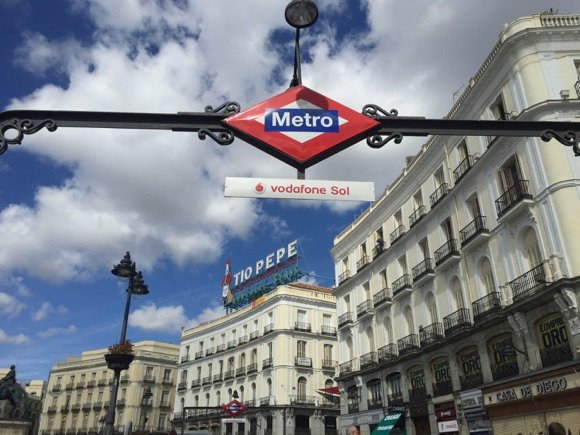
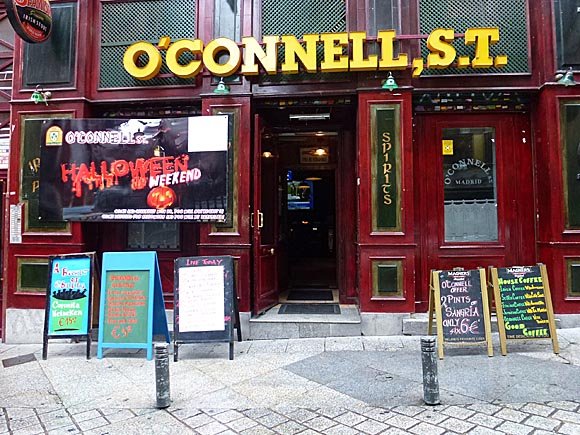
All roads lead to Sol, Madrid’s bar hub by the metro station of the same name. Among the many busy spots, O’Connell, St and adjoining Dubliners (C/Espoz y Mina 7) are the nearest expat-friendly drinking destinations guaranteed to screen Premier League action.
More pub-like haunts dot the city centre: the Triskel Tavern near Tribunal metro has been a popular football-watching option for two decades, particularly its basement, La Caverna. Also downtown is James Joyce, with three large screens near the Plaza de Cibeles where Real Madrid fans celebrate. Sports Bar Madrid at Calle Mayor 68, a short walk from Sol, is more functional but offers screens if other places are full.


Locals prefer places such as the more traditional Casa Labra and La Fontana de Oro in the Sol bar hub. Also on the local radar are the Penaltí Lounge Bars, set up by three young Madrileños in 2011, with big-screen action, affordable burgers and a special pre-match drinks menu. There’s a branch at Avenida Reina Victoria 15 near Cuatro Caminos.
Finally, football-focused La Cervecería Deportiva, now at Calle de las Veneras 7 near central Callao, is a handy spot for match-watching over tapas, cañas and platos, surrounded by mounted memorabilia.
Where to stay
The best hotels for the stadium and city centre


The Madrid Tourist Office on Plaza Mayor has a hotel-booking service.
Closest to the centrally located Bernabéu, the AC Hotel Aitana has all the trappings of a four-star in the Marriott chain, gym, restaurant and 24-hour room service. Just the other side of the Paseo de la Castellana, the stylish H10 Tribeca at C/Pedro Texeira 5 exudes urban cool, with its own Soho Restaurant and lobby bar.
With Atlético now out by the airport, staying there makes little sense unless you’re booking a room by Barajas itself, in which case there are plenty of chain choices.
Basing yourself on the Gran Vía, around the centre of town, Callao, allows easy access to Real, Atlético and bar quarter near Sol. The Indigo Madrid Gran Via (Calle de Silva 6) justifies the outlay once you’re lying by the rooftop infinity pool, the Spanish capital laid out before you.


There are more panoramic views from the Apartments Gran Vía Capital, also with a pool, plus a sauna, gym and solarium, right on the main avenue itself, at No.48. At No.32, also high-end and high up, the Hyatt Centric has flat-screen TVs as expansive as the city views from each guest room.
The next grand building along, the surprisingly affordable three-star Madrid Gran Via 25, with the same winning location and 24-hour reception.
Towards Atocha Station, the TRYP Madrid Atocha Hotel, by the southern exit of Anton Martín metro station, offers mid-range comfort and convenience. Further south, if you’re taking in a game at Rayo Vallecano, the ibis Budget Calle 30 on Calle Lozano is one metro stop or a 10min walk away.